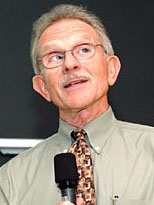
It will take decades for new technology to have a substantial impact on the staggering consumption of fuel for personal transportation, Professor John Heywood told the audience at an MIT Energy Club seminar on April 26.
But some seemingly minor changes in personal behavior can make a difference right away, said Heywood, the Sun Jae Professor of Mechanical Engineering and director of the Sloan Automotive Laboratory at MIT.
Based on population and economic growth, by 2050 there will be three times as many cars, vans, pick-up trucks and SUVs as there are now -- some 2 billion worldwide. At today's level of fuel consumption per car, that's unsupportable.
"To offset the increase in number of cars, we really need to cut fuel use per vehicle by a factor of three or four," Heywood said.
Technology can help. "Evolutionary improvements" in the technologies we know -- for example, more efficient engines and transmissions and lighter, more streamlined designs -- can make changes that add up significantly, he said. More "radical transitions" might involve vehicles running on biofuels and fuel cells and hydrogen.
But it'll be a long time before new technologies significantly reduce overall fuel consumption, Heywood said.
"I'm not saying that hydrogen is a waste of time, but don't expect it to have a serious impact in a decade," he said. "People who are working on it seriously estimate that only between 2015 and 2020 will we really know whether it's a market-competitive technology."
Heywood emphasized that cutting fuel use today -- by such obvious methods as carpooling, taking the subway and even "driving less aggressively" -- can make a difference.
"None of these measures alone is going to save us from our appetites, but several of them together could," he said.
Heywood stressed that the key is for each of us to take responsibility. He told the audience how he trained himself to turn off lights whenever he leaves a room. Each time he reminded himself, "By turning the light off, there's less carbon dioxide going into the atmosphere that'll be around for a hundred years."
"We've got to take that same sort of personal commitment and attitude into our car-buying habits and our driving behavior," he said.