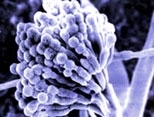
We now know more about the fungus among us.
Humans have a love-hate relationship with the aspergilli, a group of about 185 different species of fungus: several species are human pathogens, while others are the basis for the production of human food and industrial enzymes.
Now, an international team of scientists, including researchers at the Broad Institute of MIT and Harvard, have determined and compared the genome sequences of three aspergilli -- Aspergillus fumigatus, a potentially deadly human pathogen, A. oryzae, used in the production of soy sauce and sake, and A. nidulans, a model genetic organism. Their findings, published in three papers in the Dec. 22 issue of Nature, advance our understanding of the molecular basis of Aspergillus infection, provide insight into the forces driving genome evolution, and identify new genomic functional elements.
"The comparison of these organisms gives us a wealth of information about gene regulation and genome evolution that apply to the study of all eukaryotes, including humans," said James Galagan, associate director of microbial genome analysis and annotation at the Broad Institute. (Eukaryotes are organisms made up of cells with nuclei and organelles.)
"We were most excited about being able to relate genome evolution to sexual reproduction, a very specific -- and important -- physiological difference between the three aspergilli," Galagan said. Unlike A. nidulans, which has a sexual cycle, A. oryzae and A. fumigatus were believed to be asexual, but the comparative analysis suggests that both species maintain the genetic wherewithal for sexual reproduction.
If confirmed, this raises the potential for developing powerful genetic tools for both organisms, with far reaching implications for medicine (A. fumigatus) and industry (A. oryzae).
Broad Institute scientists and their colleagues determined the genome sequence of Aspergillus nidulans and, led by Galagan, performed comparative analysis of the three aspergilli. The direct genome sequence comparison of three species of aspergilli is of particular interest to scientists, given the long evolutionary history of these species as well as their different effects on human welfare. The genome sequences of A. oryzae and A. fumigatus are described in two additional papers in the same issue of Nature.
"Scientists have relied on A. nidulans to teach us about how eukaryotic cells work," said Bruce Birren, co-director of the genome sequencing and analysis program at the Broad Institute and the leader of the A. nidulans sequencing project. "Now the genome sequences are accelerating that process, and are also helping us understand what makes one fungus indispensable for food production, while its relative can cause fatal disease."
Although all three aspergilli species are considered close relatives, their respective genome sequences demonstrate remarkable diversity. Indeed, proteins compared across the aspergilli species show only about 65 percent to 70 percent amino acid identities, or about the same as that seen between humans and fish. In addition, the sizes of the genomes vary. Extensive rearrangement of all three genomes reflects the long evolutionary history of the fungi.
Despite these differences, or because of them, significant areas of similarity leap out from the analyses. Of particular note are highly conserved non-coding sequences, which presumably are genomic elements critical to the control of protein-coding genes. In the Nature article, the scientists computationally identify many such control elements, including a class of elements likely to play a significant role in regulating protein production in all eukaryotes.
A version of this article appeared in MIT Tech Talk on February 1, 2006 (download PDF).