
The Haystack 37m Telescope: A new era of astrophysical research
The legendary radio astronomy telescope returns to its science and educational mission at MIT Haystack Observatory.
The legendary radio astronomy telescope returns to its science and educational mission at MIT Haystack Observatory.
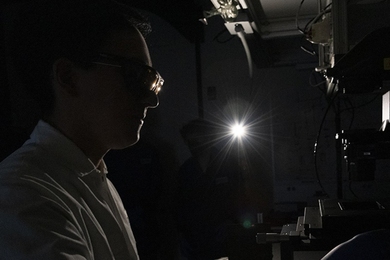
Researchers use custom-built microscopy and nanotechnology to tag and follow the activity of individual proteins in real-time.
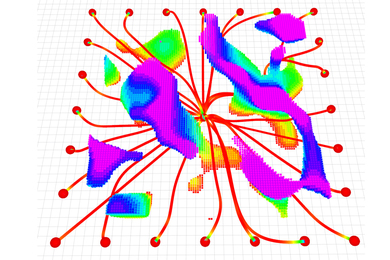
By rapidly generating a smooth path plan that cuts travel time and avoids obstacles, the open-source “MIGHTY” system could streamline disaster recovery and parcel delivery.
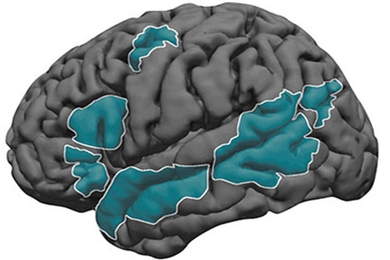
The brain’s language network is still evolving in adolescence. But by age 4, language processing is already handled by the left side of the brain, new research finds.

The discovery of dioxaborirane could expand the chemistry of boron-based reagents, providing new tools for oxidation reactions in synthesis and materials science.

A new method for precisely moving columns of individual atoms within a material could give rise to exotic quantum properties.

Using immune-remodeling mRNA molecules, researchers generated T cells that can slow tumor growth and, in some cases, eradicate tumors.

Gravitational waves emitted by colliding black holes may bear imprints of dark matter, which physicists could detect with a new model.

MIT researchers created tiny 3D photonic devices with features small enough to channel visible light.

A new technique helps scientists measure a phenomenon that can cause quantum circuits to perform differently than expected, increasing the error in computations.
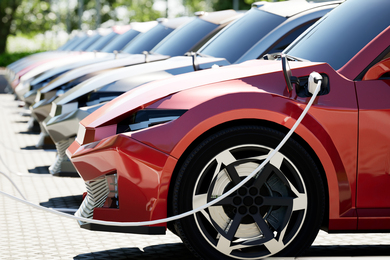
When it comes to emissions, individual driving patterns matter as much as how “green” the regional electricity mix is, MIT researchers report.

Researchers propose a challenge to the traditional view of how the brain uses its ability to categorize.

With a novel design, MIT researchers overcame a stubborn problem that has limited the effectiveness of chip-based systems for lidar.
MIT economists found US companies tend to target employees earning a “wage premium,” which increases inequality but not necessarily productivity.

The “MetaEase” technique provides a heads-up to potential scenarios that could cause long wait-times or outages.