How an MIT research project became a global programming language
With millions of users across the world, Julia has been used to conduct cutting-edge research and to design new drugs, jet engines, heat pumps, and more.
With millions of users across the world, Julia has been used to conduct cutting-edge research and to design new drugs, jet engines, heat pumps, and more.

Known for his clear and elegant writing style, Bertsekas shaped fields from control and optimization to large-scale computation and artificial intelligence.

A USAF cadet and a Lincoln Laboratory researcher found AI chatbots can help nontechnical service members produce viable software applications for their unique problems.

MIT researchers use the classic game as a test bed for AI agents, finding a small AI model can outperform the biggest ones at 1 percent of the cost.

Lincoln Laboratory intern Ivy Mahncke developed and tested algorithms to help human divers and robots navigate underwater.
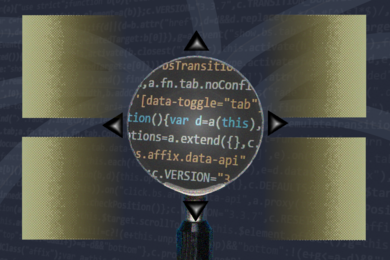
EnCompass executes AI agent programs by backtracking and making multiple attempts, finding the best set of outputs generated by an LLM. It could help coders work with AI agents more efficiently.
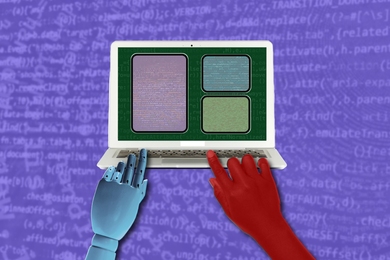
The coding framework uses modular concepts and simple synchronization rules to make software clearer, safer, and easier for LLMs to generate.
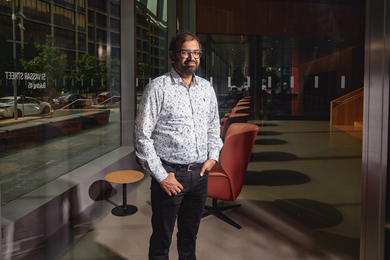
Balancing automation and agency, Associate Professor Arvind Satyanarayan develops interactive data visualizations that amplify human creativity and cognition.
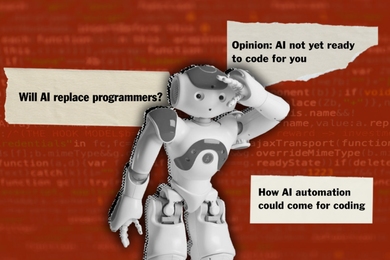
A team of researchers has mapped the challenges of AI in software development, and outlined a research agenda to move the field forward.

Caitlin Morris, a PhD student and 2024 MAD Fellow affiliated with the MIT Media Lab, designs digital learning platforms that make room for the “social magic” that influences curiosity and motivation.

Researchers share the design and implementation of an incentive-based Space Sustainability Rating.
A new technique automatically guides an LLM toward outputs that adhere to the rules of whatever programming language or other format is being used.

By automatically generating code that leverages two types of data redundancy, the system saves bandwidth, memory, and computation.
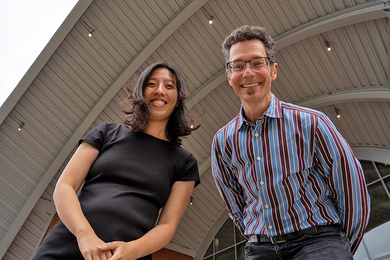
The program will invite students to investigate new vistas at the intersection of music, computing, and technology.

In controlled experiments, MIT CSAIL researchers discover simulations of reality developing deep within LLMs, indicating an understanding of language beyond simple mimicry.