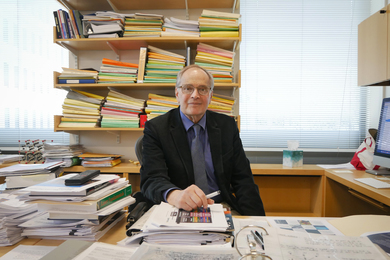
John Joannopoulos receives 2024-2025 Killian Award
The MIT physicist is honored for pioneering work in photonics that helped to advance tools for telecommunications and biomedicine.
The MIT physicist is honored for pioneering work in photonics that helped to advance tools for telecommunications and biomedicine.
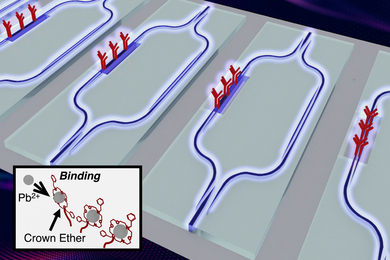
The chip-scale device could provide sensitive detection of lead levels in drinking water, whose toxicity affects 240 million people worldwide.

Seron Electronics, founded by Mo Mirvakili PhD ’17, makes research equipment with applications including microelectronics, clean energy, optics, biomedicine, and beyond.
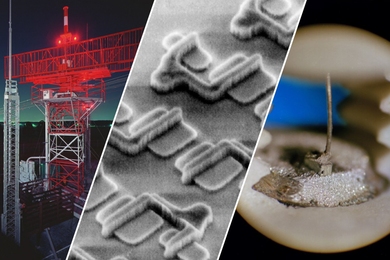
Achievements in air traffic control, microelectronics, and lasers are recognized for their lasting benefit to humanity.
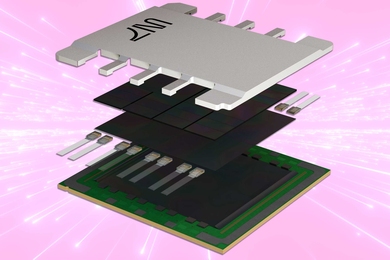
Lightmatter, founded by three MIT alumni, is using photonic computing to reinvent how chips communicate and calculate.
More stable clocks could measure quantum phenomena, including the presence of dark matter.
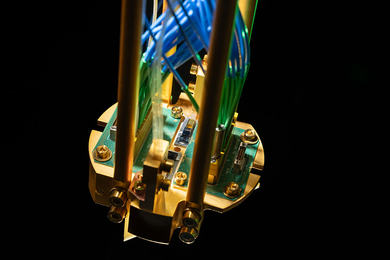
Inventions in medical imaging, aircrew scheduling, data security, and quantum networking are named among the year’s most innovative new products.
“Lightning” system connects photons to the electronic components of computers using a novel abstraction, creating the first photonic computing prototype to serve real-time machine-learning inference requests.
MIT system demonstrates greater than 100-fold improvement in energy efficiency and a 25-fold improvement in compute density compared with current systems.
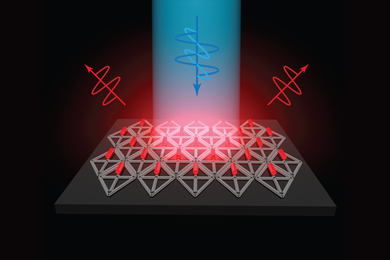
MIT engineers developed a new way to create these arrays, by scaffolding quantum rods onto patterned DNA.
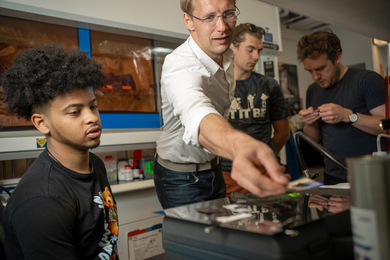
Mathias Kolle’s color-changing materials take inspiration from butterflies and mollusks.
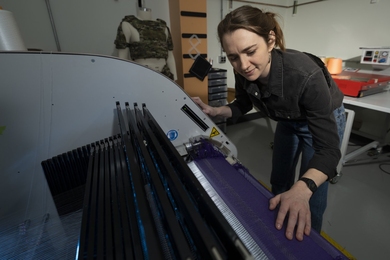
Drawing inspiration from butterfly wings, reflective fibers woven into clothing could reshape textile sorting and recycling.

Optics and photonics awards go to Professor Marin Soljacic as well as alumni Vanderlei Salvador Bagnato, Turan Erdogan, Harold Metcalf, and Andrew Weiner.
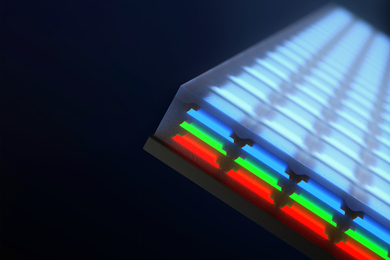
Stacking light-emitting diodes instead of placing them side by side could enable fully immersive virtual reality displays and higher-resolution digital screens.

A new method can produce a hundredfold increase in light emissions from a type of electron-photon coupling, which is key to electron microscopes and other technologies.