A lasting — and valuable — legacy
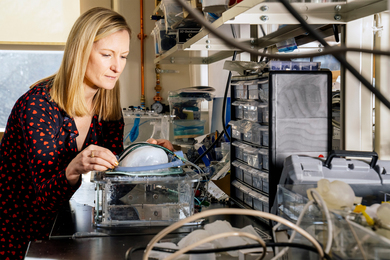
Professor Betar Gallant approaches electrochemistry with a strong inclination, inherited from her family, to work things out independently.
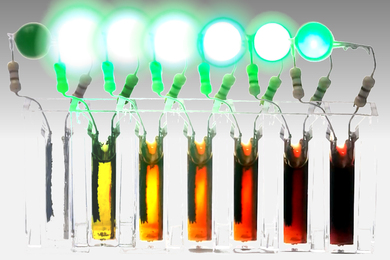
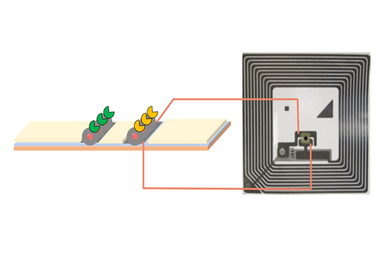
Design from the Swager Lab uses electronic polymers, rather than colored lines, to indicate a positive response, enabling quantitative monitoring of biomarkers.
An MIT-developed device with the appearance of a Wi-Fi router uses a neural network to discern the presence and severity of one of the fastest-growing neurological diseases in the world.
The device senses and wirelessly transmits signals related to pulse, sweat, and ultraviolet exposure, without bulky chips or batteries.
A new device, which doesn’t rely on immunosuppressing drugs, may assist efforts to develop an artificial pancreas to treat diabetes.
New research ties inaccuracies in pulse oximeter readings to racial disparities in treatment and outcomes.
New stamp-sized ultrasound adhesives produce clear images of heart, lungs, and other internal organs.
Engineers have developed a glucose power source that could fuel miniature implants and sensors.
The system could provide teleoperated endovascular treatment to patients during the critical time window after a stroke begins.
The AI-Guided Ultrasound Intervention Device is a lifesaving technology that helps a range of users deliver complex medical interventions at the point of injury.
Inspired by the human ear, a new acoustic fabric converts audible sounds into electrical signals.
The sticky patch could be quickly applied to repair gut leaks and tears.
Tiny Tides is an automated fast-flow instrument that can synthesize peptide-nucleic acids in a single shot.
The 2021-22 Accenture Fellows are bolstering research and igniting ideas to help transform global business.
A life-detecting radar, a microscale motor, and a quantum network architecture are among this year's most innovative new technologies.