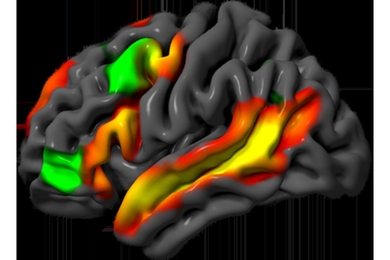
Separating logic and language
Neuroscientists find logical reasoning does not involve language-processing parts of the brain.
Neuroscientists find logical reasoning does not involve language-processing parts of the brain.
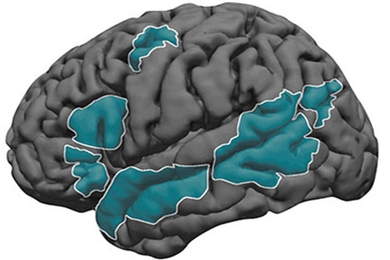
The brain’s language network is still evolving in adolescence. But by age 4, language processing is already handled by the left side of the brain, new research finds.

A new study finds that audiobooks help students learn new words — especially when paired with one-on-one instruction.

Linguistics graduate student William Pacheco hopes to preserve his endangered native language, while also becoming a better learner and educator.

Top worldwide honors span disciplines across three MIT schools for the second year in a row.
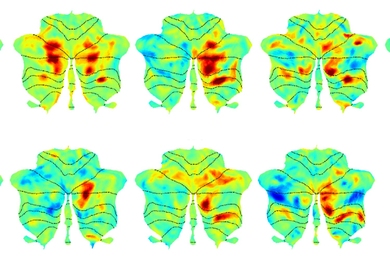
Researchers find a component of the brain’s dedicated language network in the cerebellum, a region better known for coordinating movement.

A new book by Professor Ted Gibson brings together his years of teaching and research to detail the rules of how words combine.

MISTI Japan managing director Christine Pilcavage supports students and faculty interested in exploring the country’s rich cultural traditions and heritage with a STEM flair.

MIT researchers identified three cognitive skills that we use to infer what someone really means.

Sentences that are highly dissimilar from anything we’ve seen before are more likely to be remembered accurately.

Ukrainian students and collaborators provide high-quality translations of MIT OpenCourseWare educational resources.
A new study shows LLMs represent different data types based on their underlying meaning and reason about data in their dominant language.

Cognitive neuroscientist is recognized for her groundbreaking discoveries about the brain’s language system.

The Student Ambassadors program offers MIT undergraduates from across language areas opportunities to share their voices, passion, and commitment with the community.
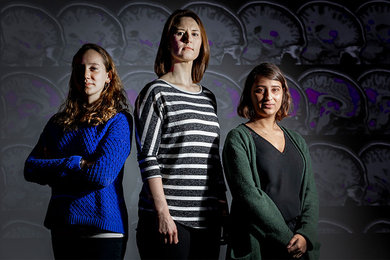
McGovern Institute neuroscientists use children’s interests to probe language in the brain.