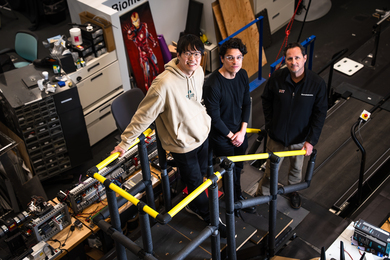
Turning muscles into motors gives static organs new life
A new biohybrid system developed at MIT is the first living implant that uses rewired nerves to revive paralyzed organs.
A new biohybrid system developed at MIT is the first living implant that uses rewired nerves to revive paralyzed organs.
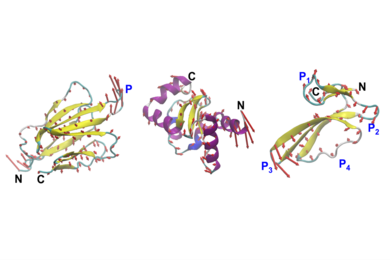
An AI model generates novel proteins based on how they vibrate and move, opening new possibilities for dynamic biomaterials and adaptive therapeutics.

Anthropologist Amy Moran-Thomas studies overlooked insights from people health care is meant to reach.
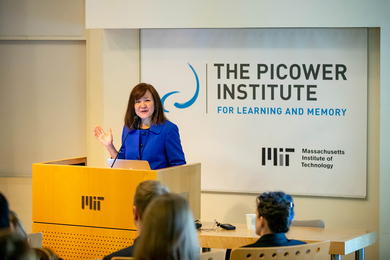
Tsai, who has grown the MIT neuroscience institute, will increase focus on research including Alzheimer’s disease and Down syndrome.
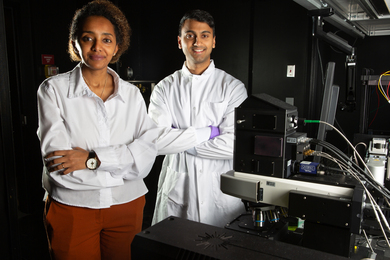
The technology could enable fast, point-of-care diagnoses for pneumonia and other lung conditions.
Researchers at MIT, Mass General Brigham, and Harvard Medical School developed a deep-learning model to forecast a patient’s heart failure prognosis up to a year in advance.
Assistant Professor Matthew Jones is working to decode molecular processes on the genetic, epigenetic, and microenvironment levels to anticipate how and when tumors evolve to resist treatment.
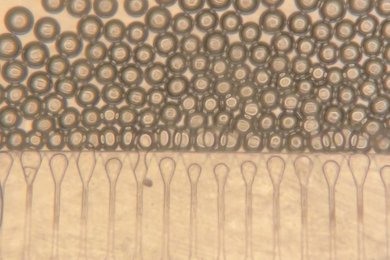
The engineered tissue grafts could take on the liver’s function and help thousands of people with liver failure.

Offering substantial prize funding alongside workshops, classes, and mentorship, the initiative helps translate early-stage biotech research into venture-ready innovation.
Researchers find mice modeling the autism spectrum disorder fragile X syndrome exhibit the same pattern of differences in low-frequency waves as humans — a new marker for treatment studies.

In STS.059 (The Bioeconomy and Society), students explore the social and political factors at work in the biology, biotech, and biological engineering sectors.

Driven by overuse and misuse of antibiotics, drug-resistant infections are on the rise, while development of new antibacterial tools has slowed.
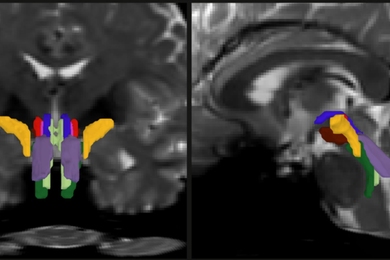
Opening a new window on the brainstem, a new tool reliably and finely resolves distinct nerve bundles in live diffusion MRI scans, revealing signs of injury or disease.
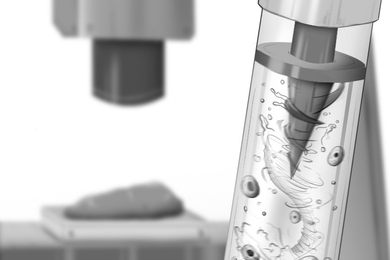
MagMix, an onboard mixing device, enables scalable manufacturing of 3D-printed tissues.
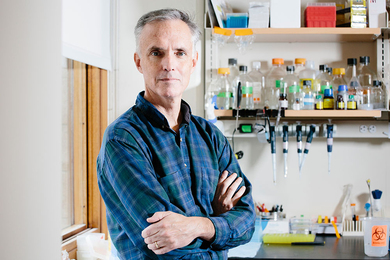
Professor James Collins discusses how collaboration has been central to his research into combining computational predictions with new experimental platforms.