
MIT researchers devise a way to evaluate cybersecurity methods
The system analyzes the likelihood that an attacker could thwart a certain security scheme to steal secret information.
The system analyzes the likelihood that an attacker could thwart a certain security scheme to steal secret information.


Global participation in MIT RAISE’s free K-12 program more than doubles in its second year.
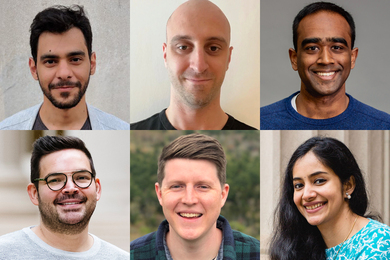
Six teams conducting research in AI, data science, and machine learning receive funding for projects that have potential commercial applications.
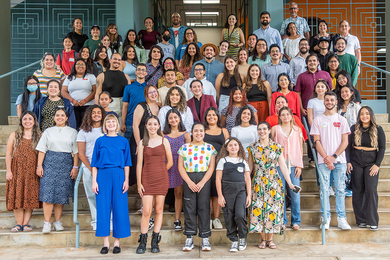
Through her organization, Sprouting, Taylor Baum is empowering teachers to teach coding and computer science in their classrooms and communities.
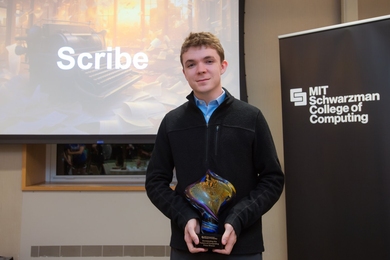
MIT students share ideas, aspirations, and vision for how advances in computing stand to transform society in a competition hosted by the Social and Ethical Responsibilities of Computing.

New online journal seeks to bring together the MIT community to discuss the social responsibilities of individuals who design, implement, and evaluate technologies.

A new AI-based approach for controlling autonomous robots satisfies the often-conflicting goals of safety and stability.
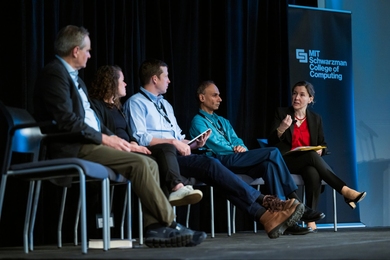
The inaugural SERC Symposium convened experts from multiple disciplines to explore the challenges and opportunities that arise with the broad applicability of computing in many aspects of society.

By applying a language model to protein-drug interactions, researchers can quickly screen large libraries of potential drug compounds.

The scientists used a natural language-based logical inference dataset to create smaller language models that outperformed much larger counterparts.

A new multimodal technique blends major self-supervised learning methods to learn more similarly to humans.

Selecting the right method gives users a more accurate picture of how their model is behaving, so they are better equipped to correctly interpret its predictions.

Researchers develop an algorithm that decides when a “student” machine should follow its teacher, and when it should learn on its own.
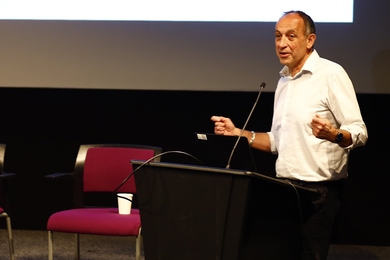
A two-day conference at MIT reflected on the impact of the Institute for Data, Systems, and Society since its launch, as founding Director Munther Dahleh prepares to step down.