Boleslaw Wyslouch steps down as director of Laboratory for Nuclear Science
Wyslouch remains the director of the Bates Research and Engineering Center and will continue research on heavy ion collisions.
The new technology, which generates high-resolution, 3D images of breast tissue, requires no expertise to operate and could be used at home.
An extensive study of U.S. cities identifies walkable neighborhoods, urban greenery, and access to amenities as key contributors to residents’ health.
A new study reveals that parts of the brain located far from the canonical language-processing centers are also involved in language comprehension.
Three MIT teams took five top awards in the 2026 NASA RASC-AL Competition for designing critical elements for the moon base and future missions to Mars.
The FUTUR-IC research program integrates electronics and photonics in microchip systems.
Using modern tools, they also determined that carbon tetrachloride, used as a dry-cleaning and degreasing agent as early as the 1930s, was at the root of early ozone loss.
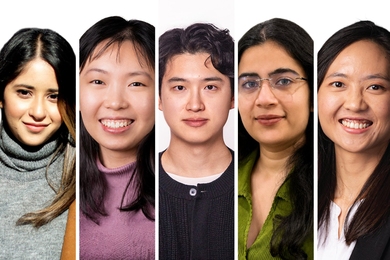
Cell biologist Whitney Henry and immunologist Harikesh Wong will receive four years of flexible funding to advance early-career research on ferroptosis and immune decision-making.
What’s more, the superconducting states get stronger under conditions expected to kill them.
A new study suggests flexibility in the timing of electricity consumption could lower consumer costs.
To help robots do chores in places like homes and factories, a new approach from MIT uses one language model to clarify users’ instructions, then another to ignore irrelevant info.
“Scientific American” showcases the history and future of America’s scientific engine, highlighting promising young scientists and icons at MIT and beyond.
In Ghana, semi-communal “compound houses” affect how much people vote and participate in political activity, new research shows.
A new system, known as Murakkab, optimizes the design and deployment of multistep workflows that power AI applications.
A new model links Earth’s mass extinctions to mismatches between rates of environmental change and biological adaptation.