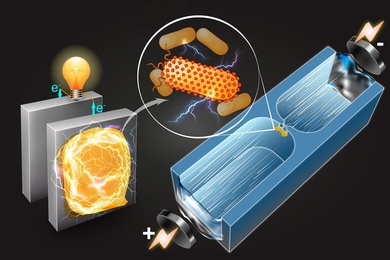
Technique identifies electricity-producing bacteria
Microbes screened with a new microfluidic process might be used in power generation or environmental cleanup.
Microbes screened with a new microfluidic process might be used in power generation or environmental cleanup.
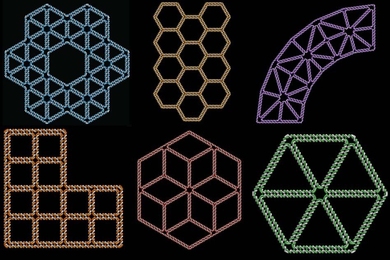
Computer program can translate a free-form 2-D drawing into a DNA structure.

Study shows the Sahara swung between lush and desert conditions every 20,000 years, in sync with monsoon activity.
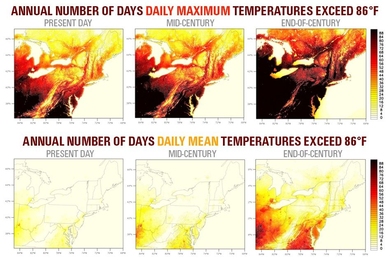
A new MIT-led study projects a dramatic increase in annual high-heat days in the U.S. Northeast by the century’s end.
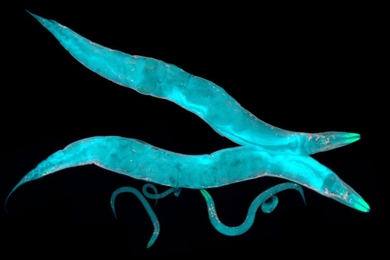
Study may lead to a better understanding of the digestive tract’s nervous system.

Less data-sharing among firms can actually lead to more collusion, economists find.
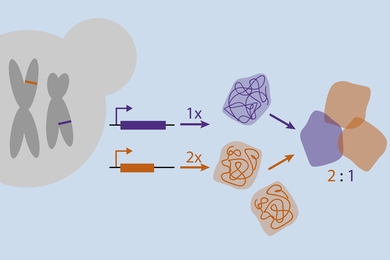
Researchers refine a method to quantify protein production, show that the precision with which bacteria and eukaryotes tune their gene expression is remarkably similar.
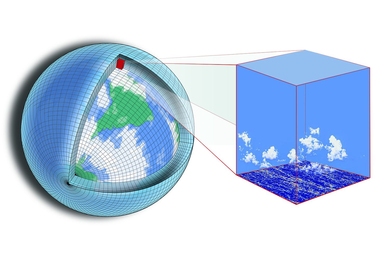
Scientists and engineers will collaborate in a new Climate Modeling Alliance to advance climate modeling and prediction.
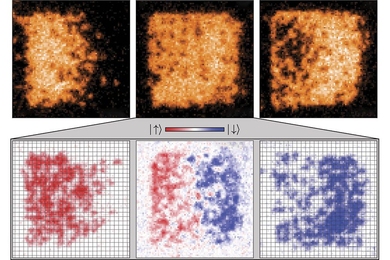
Using new “quantum emulator,” physicists can observe individual atoms moving through these materials, and measure their speed.

The observatories are also releasing their first catalog of gravitational-wave events.
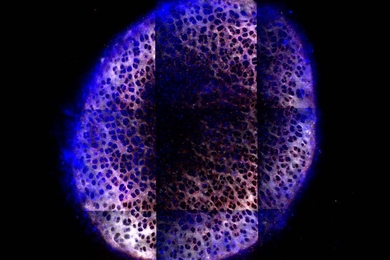
Injectable material made of nanoscale particles can deliver arthritis drugs throughout cartilage.

Study reveals the role of the activation domain, a part of transcription factors previously shrouded in mystery.
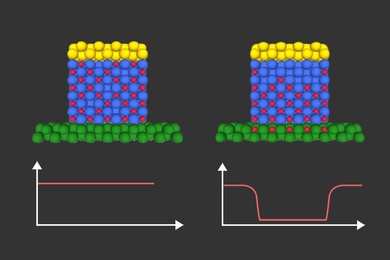
Innovative approach to controlling magnetism could lead to next-generation memory and logic devices.

Wide-ranging acoustic images could help researchers identify populations on the brink of collapse.
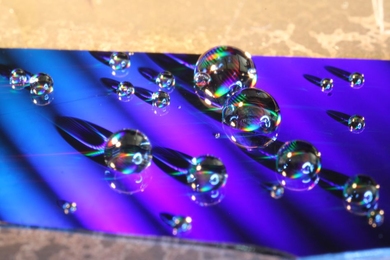
Novel surface design overcomes problem of condensation that bedeviled previous systems.