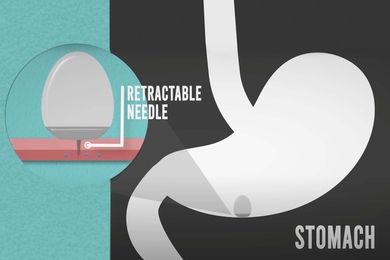
Drug delivery capsule could replace injections for protein drugs
The new pill can inject large quantities of monoclonal antibodies and other drugs into the lining of the stomach after being swallowed.
The new pill can inject large quantities of monoclonal antibodies and other drugs into the lining of the stomach after being swallowed.
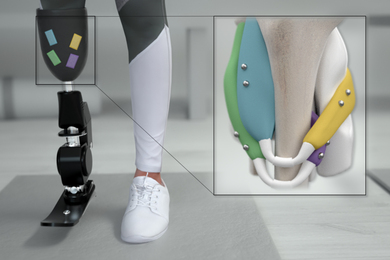
System uses tiny magnetic beads to rapidly measure the position of muscles and relay that information to a bionic prosthesis.
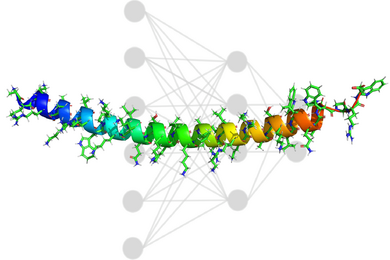
MIT researchers employ machine learning to find powerful peptides that could improve a gene therapy drug for Duchenne muscular dystrophy.

A new adhesive that mimics the sticky substance barnacles use to cling to rocks may offer a better way to treat traumatic injuries.

Technique for editing bacterial genomes can record interactions between cells, may offer a way to edit genes in the human microbiome.

The results could help scientists unravel the processes underlying plate tectonics.
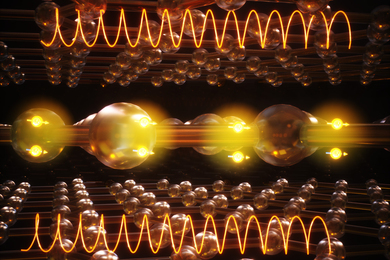
New findings might help inform the design of more powerful MRI machines or robust quantum computers.

A new seed-coating process could facilitate agriculture on marginal arid lands by enabling the seeds to retain any available water.
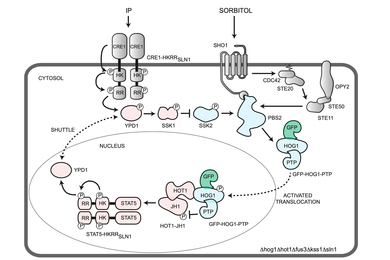
MIT engineers design the first synthetic circuit that consists entirely of fast, reversible protein-protein interactions.

Study offers evidence, based on gravitational waves, to show that the total area of a black hole’s event horizon can never decrease.

In a 3Q, Salvatore Vitale describes how gravitational-wave signals suggest black holes completely devoured their companion neutron stars.
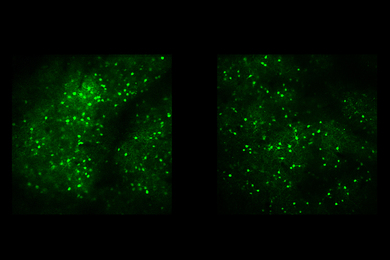
As “visual recognition memory” emerges in the visual cortex, one circuit of inhibitory neurons supplants another, and slower neural oscillations prevail.
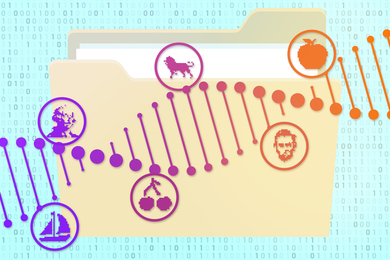
A technique for labeling and retrieving DNA data files from a large pool could help make DNA data storage feasible.

Chemical engineers have found a way to load more drug into a tablet, which could then be made smaller and easier to swallow.

In a first, the digital fiber contains memory, temperature sensors, and a trained neural network program for inferring physical activity.