
Q&A: Holly Jackson on building a cosmic family tree
Undergraduate in electrical engineering and computer science contributes to startling new astronomy research.
Undergraduate in electrical engineering and computer science contributes to startling new astronomy research.
Identifying primordial ripples would be key to understanding the conditions of the early universe.
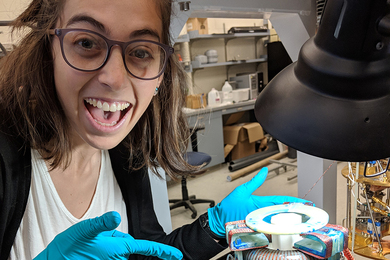
Grad student Chiara Salemi and Professor Lindley Winslow use the ABRACADABRA instrument to reveal insights into dark matter.

MIT postdoc finds the angle at which we view neutron star collisions could significantly impact age measurements.
Findings on short-range nuclear interactions will help scientists investigate neutron stars and heavy radioactive nuclei.
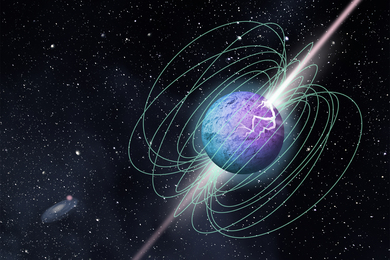
The fast radio bursts are likely generated by a magnetar, the most magnetic type of star in the universe.
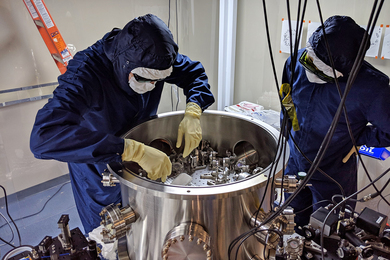
Nicholas Demos, a first-generation college graduate and MathWorks Fellow in MIT’s Kavli Institute, is improving our ability to listen to the cosmos.

MIT alumna and two others honored for discoveries in black hole physics.
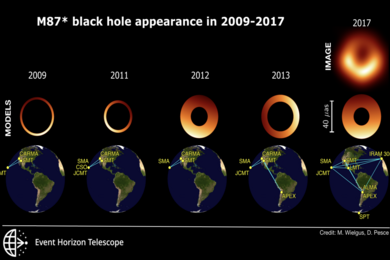
Analysis of Event Horizon Telescope observations from 2009 to 2017 reveals turbulent evolution of the M87* black hole image.
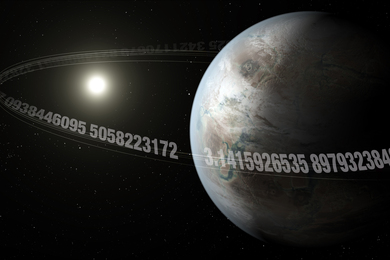
The rocky world, with its baking-hot surface, is likely not habitable.
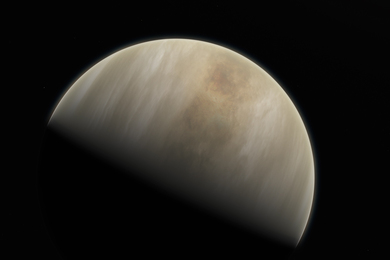
Evidence indicates phosphine, a gas associated with living organisms, is present in the habitable region of Venus’ atmosphere.
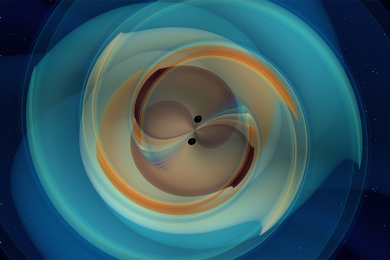
A binary black hole merger likely produced gravitational waves equal to the energy of eight suns.
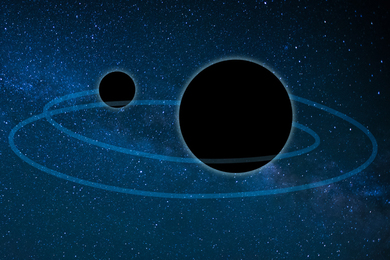
Researchers suggest a novel process to explain the collision of a large black hole and a much smaller one.
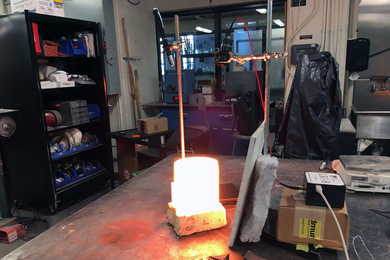
By making their own lava and cooled glass, scientists find these materials likely aren’t responsible for the unexpected glow of some exoplanets.
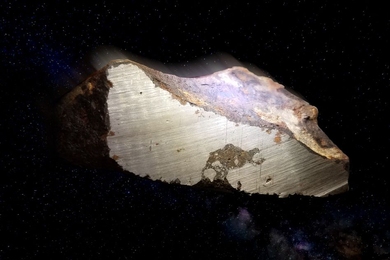
Study suggests the rare objects likely came from an early planetesimal with a magnetic core.