Entrepreneurship and MIT have become a classic pairing, with a storyline that seems to write itself: A researcher develops a brilliant innovation in the lab, spins out a company, and brings a product to market that saves lives or improves society. It happens, sure — but long-term startup success is far from guaranteed.
That’s the challenge that prompted the launch of the MIT Kavanaugh Translational Fellows Program a decade ago, giving scholars who want to turn academic research into solutions to pressing challenges the time, tools, and business training to improve their chances of success.
“MIT has this world-class research facility and faculty and everything, but it also has world-class entrepreneurial programs,” says Nick Diaco, an MIT postdoc and 2025 Kavanaugh Fellow, in a new video about the program. “You really need both if you actually want to take an idea from the lab and put it into the real world and put it into situations where it’s actually affecting people’s lives.”

The program’s focus reflects a fundamental challenge for academic innovators: developing a promising technology is only the beginning. Turning it into a viable business requires making difficult decisions about customers, markets, financing, and other factors that may fall outside a typical researcher’s expertise.
“Even in a place like MIT, the majority of those people who choose to start businesses or bring that product to another business, the majority are going to fail,” said philanthropist Bart Kavanaugh at a May event announcing the 2026 fellows. Kavanaugh is one of the namesakes of the Saks-Kavanaugh Foundation, which supports the fellowship. He and his wife, Betty Saks, run the organization.
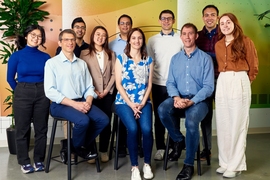
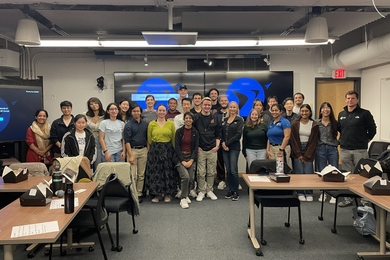
The foundation, he explained, analyzed what distinguishes successful startups. The selection process for the fellowship, he told the three new fellows — John Zhang, Maximiliano Jara Fornerod, and Xinyuan Zhang — is intended to identify researchers who have the potential to succeed.
The three are developing technologies ranging from a faster way to manufacture custom optical lenses to at-home strep throat tests and infrared detectors that can operate without energy-intensive cryogenic cooling.
They join a growing legacy of Kavanaugh Fellows whose research has moved toward commercialization, including Sublime Systems, a manufacturer of low-carbon cement; SiTration, which develops technology for extracting materials; and Stratagen Bio, which develops tools for quantitative biomarker assessment.
The yearlong program, managed by MIT’s Department of Materials Science and Engineering, gives MIT scholars time to focus on the business side of their ideas and develop the planning and decision-making skills needed to move promising research beyond the lab.
“If while you’re doing your research, you’re able to set aside some time to investigate the commercial potential before you leave the university, you get a really good picture on, 'is this a good idea for commercialization?'” says Diana Mojahed in the video. Mojahed was a postdoc at MIT when she became a 2023 Kavanaugh Fellow and is now the CEO of Lightfinder, which makes handheld spectrometers for health care, manufacturing, and telecommunications.
“It’s so much more than just achieving good specs with whatever you’re trying to achieve. There has to be a market for it. The unit economics need to work out. There’s a lot that goes into building a company.”
Learn more about the Kavanaugh Translational Fellows Program.