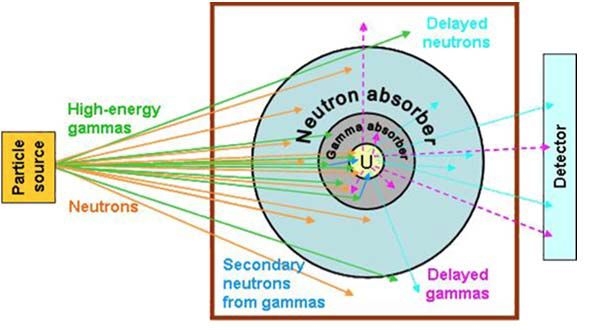
A research collaboration led by MIT has received a five-year $5 million grant from the National Science Foundation and the Domestic Nuclear Detection Office of the Department of Homeland Security to study new approaches to the detection of shielded nuclear material.
The approach proposed by MIT involves a new method for producing monoenergetic gamma rays which can penetrate materials and can clearly differentiate between ordinary materials and special nuclear materials (SNM) such as uranium, while reducing the radiation dose by a factor of 20 relative to previous approaches. The new system will combine a unique radiation source with new concepts in detectors and new approaches to inference and data analysis algorithms that can clearly delineate between potential threats and benign materials using both statistical inferences and physics-based simulations.
The overarching goal of the project is to develop a novel approach to the active detection of shielded nuclear materials while in transit with an easily relocatable low-dose system. The system approach will be such that a fast screen can be made to rapidly clear the vast majority of objects which pose no threat and, if a potential threat is detected, to use the same system to positively identify the presence of nuclear materials.
The MIT team includes scientists from NSE (Richard Lanza, overall project PI) and CSAIL (John Fisher), as well as collaborators from Penn State (Igor Jovanovic, Zoubeida Ounaies) and Georgia Tech (Anna Erickson).
The approach proposed by MIT involves a new method for producing monoenergetic gamma rays which can penetrate materials and can clearly differentiate between ordinary materials and special nuclear materials (SNM) such as uranium, while reducing the radiation dose by a factor of 20 relative to previous approaches. The new system will combine a unique radiation source with new concepts in detectors and new approaches to inference and data analysis algorithms that can clearly delineate between potential threats and benign materials using both statistical inferences and physics-based simulations.
The overarching goal of the project is to develop a novel approach to the active detection of shielded nuclear materials while in transit with an easily relocatable low-dose system. The system approach will be such that a fast screen can be made to rapidly clear the vast majority of objects which pose no threat and, if a potential threat is detected, to use the same system to positively identify the presence of nuclear materials.
The MIT team includes scientists from NSE (Richard Lanza, overall project PI) and CSAIL (John Fisher), as well as collaborators from Penn State (Igor Jovanovic, Zoubeida Ounaies) and Georgia Tech (Anna Erickson).