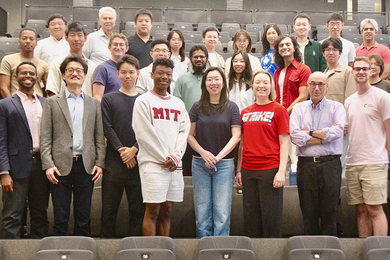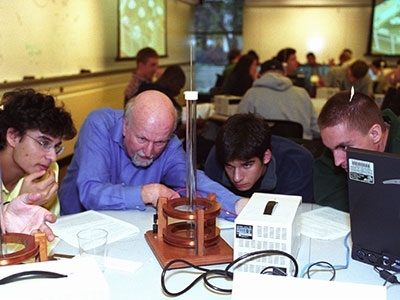
The Committee on Education (COE) of the American Physical Society (APS) recently announced the recipients of the 2012 Award for Improving Undergraduate Physics Education, and MIT's Department of Physics was one of four institutes honored. The award recognizes physics departments and/or undergraduate-serving programs in physics that support best practices in education at the undergraduate level.
In a press release, the APS noted: "MIT has engineered an impressive transformation of its undergraduate physics curriculum, which currently produces the largest number of bachelor's degrees in physics annually of any university in the United States. The Department has more than doubled the number of majors since 2001, accompanied by a focus on diversity that has resulted in a department in which more than a third of graduating seniors are women."
The American Physical Society is a non-profit membership organization working to advance and diffuse the knowledge of physics through its research journals, scientific meetings, and education, outreach, advocacy and international activities.
Read the full press release
In a press release, the APS noted: "MIT has engineered an impressive transformation of its undergraduate physics curriculum, which currently produces the largest number of bachelor's degrees in physics annually of any university in the United States. The Department has more than doubled the number of majors since 2001, accompanied by a focus on diversity that has resulted in a department in which more than a third of graduating seniors are women."
The American Physical Society is a non-profit membership organization working to advance and diffuse the knowledge of physics through its research journals, scientific meetings, and education, outreach, advocacy and international activities.
Read the full press release