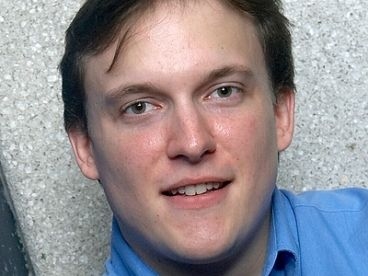
MIT physicist Martin Zwierlein has won a 2010 David and Lucille Packard Fellowship — a five-year, unrestricted research grant totaling $875,000. Zwierlein, an assistant professor of physics, is one of 17 recipients of this year’s awards, which are among nation's largest nongovernmental fellowship prizes.
Zwierlein will use the funds to support research that employs ultracold atomic gases, a million times colder than interstellar space, to study strongly interacting systems in a fully controllable environment, and to investigate models of high-temperature superconductivity by confining fermionic superfluids in lower dimensions and in optical lattices, artificial crystals of light.
“Each year, we are inspired by the early career science and engineering faculty we are able to support through these fellowships,” said Lynn Orr, the Keleen and Carlton Beal Professor at Stanford University, and chair of the Packard Fellowship Advisory Panel. “These professors are tackling some of the critical research questions of our time, and we know they will have a big impact not just on their fields but also on the students who are fortunate enough to work with them.”
The 2010 Fellows were nominated by presidents of 50 universities that participate in the Packard Fellowship program. The 100 nominations were reviewed by the Fellowship Advisory Panel, a group of nationally recognized scientists, which then recommended 17 Fellows for approval by the Packard Foundation Board of Trustees.
The David and Lucile Packard Foundation is a private family foundation created by David Packard, cofounder of the Hewlett-Packard Company.
In the physics department, Pablo Jarillo-Herrero, assistant professor of physics, is a current Packard Fellow, and Professors Jacqueline Hewitt, Wolfgang Ketterle, Ray Ashoori and Max Tegmark are former Packard Fellowship winners.
Zwierlein will use the funds to support research that employs ultracold atomic gases, a million times colder than interstellar space, to study strongly interacting systems in a fully controllable environment, and to investigate models of high-temperature superconductivity by confining fermionic superfluids in lower dimensions and in optical lattices, artificial crystals of light.
“Each year, we are inspired by the early career science and engineering faculty we are able to support through these fellowships,” said Lynn Orr, the Keleen and Carlton Beal Professor at Stanford University, and chair of the Packard Fellowship Advisory Panel. “These professors are tackling some of the critical research questions of our time, and we know they will have a big impact not just on their fields but also on the students who are fortunate enough to work with them.”
The 2010 Fellows were nominated by presidents of 50 universities that participate in the Packard Fellowship program. The 100 nominations were reviewed by the Fellowship Advisory Panel, a group of nationally recognized scientists, which then recommended 17 Fellows for approval by the Packard Foundation Board of Trustees.
The David and Lucile Packard Foundation is a private family foundation created by David Packard, cofounder of the Hewlett-Packard Company.
In the physics department, Pablo Jarillo-Herrero, assistant professor of physics, is a current Packard Fellow, and Professors Jacqueline Hewitt, Wolfgang Ketterle, Ray Ashoori and Max Tegmark are former Packard Fellowship winners.