
After suffering heart attacks, patients often receive stents designed to hold their arteries open. Some of these stents release drugs that are meant to halt tissue growth in arteries, but can have life-threatening side effects such as increasing the likelihood of blood clots and heart attacks.
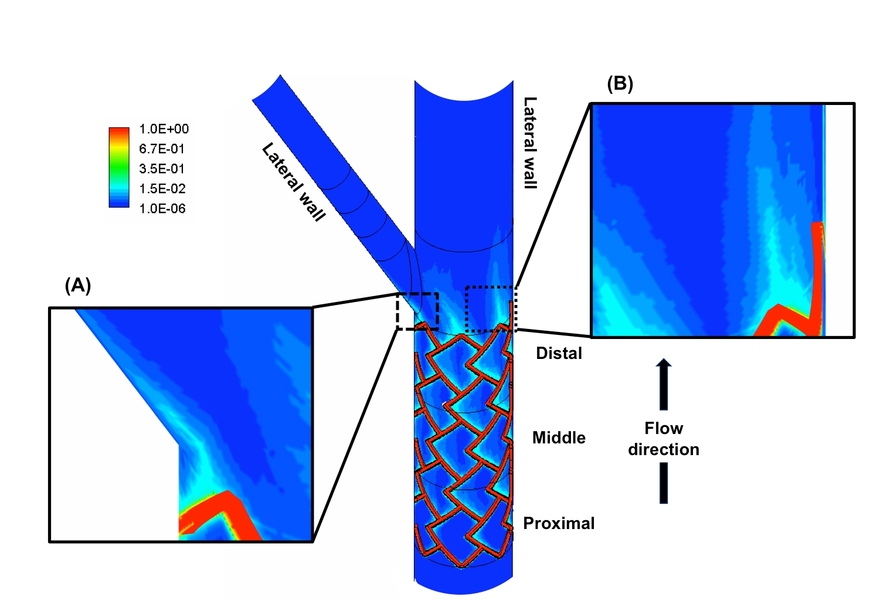
Now a team of researchers in the MIT-Harvard Division of Health Sciences and Technology has developed a computer model that explains why those drugs (which include rapamycin and its analogs as well as paclitaxel) can accumulate in the arteries and cause blood clots.
The model allows the scientists to predict, for the first time, drug distribution in branched arteries. Their findings explain why drugs can pile up in certain areas, depending on where the stent is placed relative to forks in the artery.
“By observing the arterial drug distribution patterns for various settings, we understood that drug released from the stent does not reach uniformly to all regions of the vessel and this non-uniformity depends on where the stent is placed in the artery as well as the blood flow that is entering the vessel,” says Edelman.
More than one million patients in the United States receive drug-releasing stents per year.
The results, reported today in PLoS One, could help stent developers design safer and more effective stents and raises the possibility of designing individualized stents for patients. It could aid the FDA in its approval process for stents.
Now a team of researchers in the MIT-Harvard Division of Health Sciences and Technology has developed a computer model that explains why those drugs (which include rapamycin and its analogs as well as paclitaxel) can accumulate in the arteries and cause blood clots.
The model allows the scientists to predict, for the first time, drug distribution in branched arteries. Their findings explain why drugs can pile up in certain areas, depending on where the stent is placed relative to forks in the artery.
“By observing the arterial drug distribution patterns for various settings, we understood that drug released from the stent does not reach uniformly to all regions of the vessel and this non-uniformity depends on where the stent is placed in the artery as well as the blood flow that is entering the vessel,” says Edelman.
More than one million patients in the United States receive drug-releasing stents per year.
The results, reported today in PLoS One, could help stent developers design safer and more effective stents and raises the possibility of designing individualized stents for patients. It could aid the FDA in its approval process for stents.