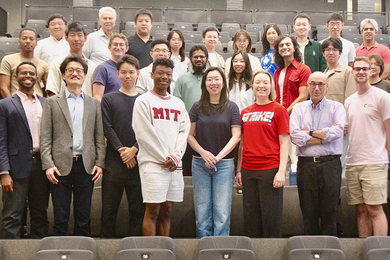
William M. Harris pictures revitalized inner cities where ethnically, socially and economically diverse residents live, work and educate their children in vital, stress-free communities.
Harris, professor of planning in the Department of Urban and Regional Planning at Jackson State University, is an MIT Martin Luther King Jr. Visiting Professor for 2006-2007.
"I don't see utopia," he said. "I see viable living arrangements in the inner city. One of the problems with housing patterns in the U.S. is that they are vigorously and fiercely segregated by race, social status and, to some extent, religion and ethnicity. I'm here at MIT to try to write a strategy, a proposal for rebuilding inner cities around issues of race and class and ethnicity.
"This will require a new direction and innovative strategies for African-American community and economic development in the 21st century," he said.
He is hopeful that with planning, it can happen.
It has happened, he said, in Columbia, Md., where a diverse, socially integrated, racially desegregated community exists. It has happened as well in East Lake, near Atlanta, where "people live in reasonable harmony and educate their children in the same milieu."
Both, however, are primarily bedroom communities. Harris's vision includes public and private economic development enterprises that would not only invest in various levels of housing stock but also provide jobs "close to home so people can earn a decent living and not have to resort to underground activities to make ends meet."
Although Harris acknowledges that his view sounds utopian, he is a realist. Change will be incremental and painstaking, and not everyone will be happy with the pace. Communities may have to take on more responsibility for their own revitalization than in the past, he said, and attitudes of both poorer and more affluent residents may have to change radically.
But the alternative--gentrification without consideration for the existing population--is worse. Boston's South End is an example of what happens when residents are forced out of their neighborhood because they cannot afford climbing rents. "Gentrification is like stepping on a balloon," Harris said. "You blow air from one place to another. All the issues are moved to another area. Public-private investments in economic development and housing are key, to benefit the people in place as well as to bring in new blood, new vitality and to stabilize the public schools."
A version of this article appeared in MIT Tech Talk on May 9, 2007 (download PDF).