Skip to content ↓

Bridge work

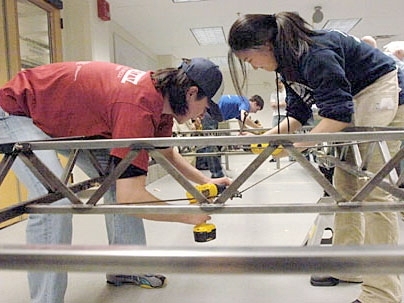
Members of MIT's regional Steel Bridge Competition team replicated their high-speed construction at a department celebration of their victory. Shown in the photo are junior Tracy Takemura, right, and sophomore Jose Cano, left. Quinn Vollmert, a junior, is in blue T-shirt at back.
Caption:
Members of MIT's regional Steel Bridge Competition team replicated their high-speed construction at a department celebration of their victory. Shown in the photo are junior Tracy Takemura, right, and sophomore Jose Cano, left. Quinn Vollmert, a junior, is in blue T-shirt at back.
Credits:
Photo / Donna Coveney

A team of eight undergraduates in civil and environmental engineering won the award for fastest construction and took second place overall in the regional Steel Bridge Competition held March 16-17 at the University of Connecticut, earning a chance to compete at the national competition May 25 and 26 at California State University, Northridge.

Five people on the MIT team took just under seven minutes to assemble their 32-piece bridge in the competition. Judges scored teams on constructability, usability, stiffness, construction speed, efficiency, economy and looks. Teams transported their bridge prototypes in pieces, assembled them at the competition and then applied a 2,500-pound load. The lowest score won.

Junior Tracy Takemura, president of the MIT Civil and Environmental Engineering Student Association, said the team "learned a lot about how we can improve upon our bridge. We had overdesigned our lateral strength, so we will be minimizing cross-bracings to decrease overall weight. We can also cut down on builders--to have four total--to cut builder costs."

A version of this article appeared in MIT Tech Talk on April 4, 2007 (download PDF).
Related Links

Related Topics

More MIT News

Globular blue and white orbs "examining" single-stranded RNA products and marking them with green checks or red x's

Why are some bacterial genes high in purines?

In certain species of bacteria, the answer lies in shielding RNA transcripts from a quality-control factor called Rho. Understanding the requirements for expressible sequences is critical for expression engineering of therapeutic agents.

Read full story

Rich Nielsen, Volha Charnysh, Kevin Dorst, and Emily Richmond Pollock seated at a table, talking

Building a scholarly community

The SHASS Faculty Fellows Program, administered by the MIT Human Insight Collaborative, is fostering new research projects and creating space for supportive and interdisciplinary discussion.

Read full story