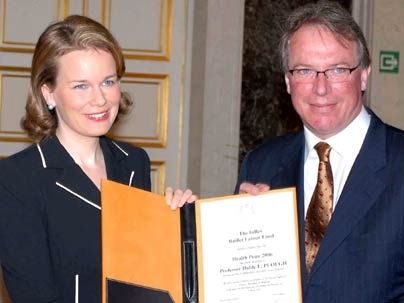
Princess Mathilde of Belgium presented Hidde Ploegh, MIT biology professor and member of the Whitehead Institute, with the 2006 Interbrew-Baillet Latour Health Prize on Saturday, May 6.
The prize, worth 150,000 euros (about $192,000), is the largest scientific prize awarded in Belgium. Sponsored by the InBev-Baillet Latour Fund, the award is given annually to one or two scientists "to recognize the merits of a person whose work has contributed prominently to the improvement of human health."
According to a statement released by the foundation, Ploegh "has made fundamental discoveries on how abnormal proteins are broken down in cells and how viruses manipulate these processes to gain advantage. His work has changed our understanding of how normal cells eliminate newly made proteins that are incorrectly folded, and of how viruses evade immune responses."
One of the world's leading researchers in immune system behavior, Ploegh studies the various tactics that viruses employ to evade our immune responses, and the ways in which our immune system distinguishes friend from foe. His findings have implications for both vaccine and drug development.
A version of this article appeared in MIT Tech Talk on May 17, 2006 (download PDF).