Skip to content ↓

Annual origami competition gets under way

Will you join the fold?
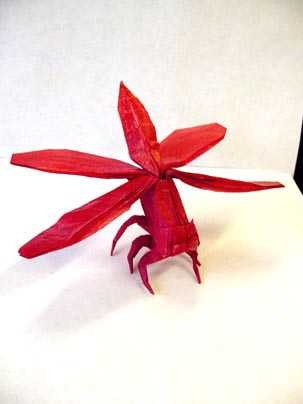
Origami skimmer dragonfly folded by graduate student Brian Chan, who won  Best Technical Folding and Best Original Design for his leaves and insects collection in the 2005 origami contest.
Caption:
Origami skimmer dragonfly folded by graduate student Brian Chan, who won Best Technical Folding and Best Original Design for his leaves and insects collection in the 2005 origami contest.
Credits:
Photo / Elsa Chen

Folding's fine, but not spindling or mutilating. Taping and trimming are also taboo.

Submissions for the fourth annual Student Origami Competition are due in the Office of the Arts (Room E15-205) by 5 p.m. Tuesday, Feb. 21.

The competition, open to MIT students and sponsored by the Office of the Arts/Student & Artist-in-Residence Programs, the MIT Japan Program and the office of Associate Professor Erik Demaine, is designed to promote interest in origami within the MIT community and to showcase student work.

Models must be made entirely by folding -- no glue or tape can be used -- although they may be modular. Both original designs and credited executions of existing designs are welcome and will be judged in separate categories by a jury of origami experts. Past submissions have included everything from bugs and flowers to stars and helixes. Winning entries will be exhibited in the Wiesner Student Art Gallery.

For more information, or to see images of past submissions, visit http://web.mit.edu/arts/special_programs/studentp/origami.html. Or, e-mail Irene Brisson, irony@mit.edu.

A version of this article appeared in MIT Tech Talk on January 25, 2006 (download PDF).

Related Links

Related Topics

More MIT News

Rich Nielsen, Volha Charnysh, Kevin Dorst, and Emily Richmond Pollock seated at a table, talking

Building a scholarly community

The SHASS Faculty Fellows Program, administered by the MIT Human Insight Collaborative, is fostering new research projects and creating space for supportive and interdisciplinary discussion.

Read full story

Globular blue and white orbs "examining" single-stranded RNA products and marking them with green checks or red x's

Why are some bacterial genes high in purines?

In certain species of bacteria, the answer lies in shielding RNA transcripts from a quality-control factor called Rho. Understanding the requirements for expressible sequences is critical for expression engineering of therapeutic agents.

Read full story