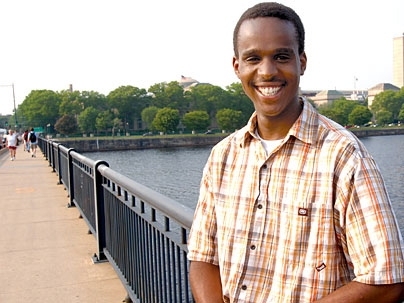
Without the Internet, graduating senior Eric Mibuari said he would never have known about MIT.
"That was a time when the Internet was getting really big in Kenya," explained Mibuari, an aeronautics and astronautics major.
During the gap year between high school and college that most Kenyan students take, Mibuari took information technology courses. "I realized that IT had a lot of potential," Mibuari said.
While surfing the Internet, Mibuari found a path to his future. Coming to MIT was amazing, Mibuari said, calling his four years here both "challenging and rewarding."
Mibuari decided he wanted to share those skills back home.
After attending Leader Shape at MIT, an intensive six-day leadership-development and community-building program, he got the idea to start a community computer center in Laare, Kenya, the town where he grew up.
"I just thought about how much IT helped me personally," Mibuari said. "Many people in Kenya have not even seen a computer in their lives."
Basic computer skills -- especially word processing -- are helpful when young people seek jobs after high school, Mibuari said. The center he envisioned would focus primarily on those basic skills.
Armed with 12 older computers donated by MIT Libraries, Mibuari received a Public Service Center (PSC) fellowship for the January 2005 Independent Activities Period (IAP) to head to Kenya and start his new computer center in a room donated by a local church.
In just one month, Mibuari set the computers up -- no small task in a room without electrical outlets -- hired an instructor and a management team and advertised the new venture.
Mibuari formed collaborations with local universities that he hoped would sustain the center once he was back at MIT. He returned the following IAP, also on a PSC fellowship.
"The management had not worked out as I had hoped," Mibuari said.
During his second IAP visit, this past January, Mibuari held management seminars in Kenya and worked on a recruitment plan for students. He also worked with the management team to establish an annual plan.
Since then, the center has flourished. A local land developer even donated a plot to build a freestanding center.
"I am really happy I went back," said Mibuari, who hopes that the center will continue to grow, even after he graduates and begins a full-time job at Citigroup in Boston.
"Eventually, I would like to go home," said Mibuari. "I do feel like I have built an incredible set of skills here at MIT."
A version of this article appeared in MIT Tech Talk on June 7, 2006 (download PDF).