Skip to content ↓

Urban housing showcased

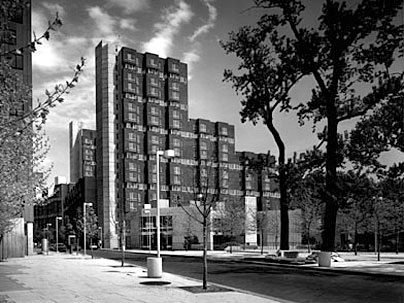
This photo of Eastwood, a housing project on Roosevelt Island in New York City, is part of a current exhibit at the Wolk Gallery. The development, designed by Sert, Jackson & Associates, was built in 1974.
Caption:
This photo of Eastwood, a housing project on Roosevelt Island in New York City, is part of a current exhibit at the Wolk Gallery. The development, designed by Sert, Jackson & Associates, was built in 1974.
Credits:
Photo / Steve Rosenthal

The Wolk Gallery (Room 7-338) opens its 2006-07 season with an exhibition of past and current housing programs for people of limited income. "Policy and Design for Housing: Lessons of the Urban Development Corporation, 1968-1975" documents one of the most innovative and effective housing programs ever developed in the United States.

An opening reception will be held today from 5:30 to 7:30 p.m.

Launched by Gov. Nelson A. Rockefeller, the New York State Urban Development Corporation (UDC) was given both broad political powers and financial resources to fulfill its mandate--improving the physical environment for low- and moderate-income families. The UDC built 33,000 units of housing and three new communities that are still in existence today.

The MIT exhibition showcases the UDC's legacy and its effectiveness, exploring selected projects that demonstrate housing set in various contexts--urban and suburban, high- and low-density--and built according to various social and design guidelines--mixed income; high-rise and low-rise. UDC structures also employed various building materials and technologies.

The show runs through Dec. 22 and is open weekdays from 9 a.m. to 5 p.m.

A version of this article appeared in MIT Tech Talk on September 20, 2006 (download PDF).

Related Topics

More MIT News

Globular blue and white orbs "examining" single-stranded RNA products and marking them with green checks or red x's

Why are some bacterial genes high in purines?

In certain species of bacteria, the answer lies in shielding RNA transcripts from a quality-control factor called Rho. Understanding the requirements for expressible sequences is critical for expression engineering of therapeutic agents.

Read full story

Rich Nielsen, Volha Charnysh, Kevin Dorst, and Emily Richmond Pollock seated at a table, talking

Building a scholarly community

The SHASS Faculty Fellows Program, administered by the MIT Human Insight Collaborative, is fostering new research projects and creating space for supportive and interdisciplinary discussion.

Read full story