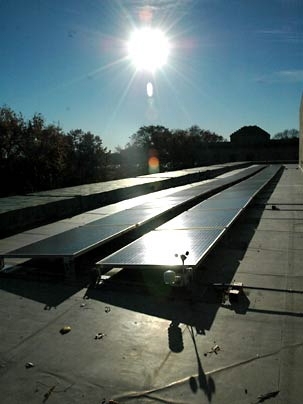

As the autumn sun set, MIT celebrated the completion of its third and largest solar installation at Hayden Memorial Library on Monday, Nov. 14.
President Susan Hockfield seized the moment of natural beauty to affirm the Institute's commitment to innovations in energy use.
Thanks to the MIT Community Solar Power Initiative and to those who installed the 42 solar panels on the library's roof, much of the sun's "energy is being captured and converted to electricity to help power a portion of the essential functions of this library," Hockfield said.
The president noted that the installation of the system atop the library represented the successful culmination of a project to promote sustainable energy on campus and facilitate education and research in solar power as well as to reduce MIT's emissions footprint.
Jamie Lewis Keith, senior counsel and managing director for MIT Environmental Programs, noted that Hockfield had charged MIT with applying its multidisciplinary creativity to addressing the world's enormously complex energy challenges when she was inaugurated last May.
Keith's remarks at Monday's ribbon cutting pointed to MIT's goals -- leadership in energy and environmental research and education -- and its environmental policies, which commit the Institute to environmental stewardship on campus, regionally and globally.
Keith welcomed Cambridge Mayor Michael Sullivan; Ann Wolpert, director of the MIT Libraries; and Mitchell Adams, executive director of the Massachusetts Technology Collaborative (MTC).
MTC administers the Renewable Energy Trust Fund, which provided $455,700 in funding to launch MIT's Community Solar Power Initiative in 2002.
Hockfield thanked Adams and MTC for the "financial incentives to get this project off the ground and for investing in the Massachusetts innovation economy."
The library roof was selected for the solar installation by the Department of Facilities for its southern exposure. The 12,000-watt system on the library's roof is comprised of 42 panels, each measuring 2 feet by 5 feet and containing 72 photo voltaic cells. The system will generate around 15,000 kilowatt hours a year -- roughly equivalent to the energy needed to power two homes for a year. The production of the electricity will result in zero greenhouse gas emissions and will supplement power provided by MIT's co-generation plant on Vassar Street.
Solar panels are also installed at the MIT Museum (N52) and at the Student Center; those panels generate a combined total of 11,500 kilowatt hours.
The MIT Department of Facilities and the Laboratory for Energy and the Environment (LFEE) received the initial grants to launch 40 solar installations on campus as well as at schools, homes and businesses in Cambridge, Watertown, Arlington, Lexington and Waltham.
To learn more about the MIT Community Solar Power Initiative and view photos of solar power panel installations go to solarpower.mit.edu.
A version of this article appeared in MIT Tech Talk on November 16, 2005 (download PDF).