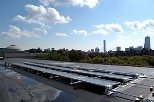
MIT's first solar-energy installation--a swath of panels some 60 feet long by 15 feet wide atop the Stratton Student Center--was the focus of a ribbon-cutting ceremony by Cambridge Vice Mayor Henrietta Davis on Oct. 15.
The installation was funded by a grant to the MIT Community Solar Power Initiative by the Massachusetts Technology Collaborative. The grant will fund installations totaling 75kW on the MIT campus and homes, including those of faculty, staff and alumni in a cluster of towns.
The Cambridge home of Jack Turner, associate director of the Technology Licensing Office, is the first completed residential installation. MIT-affiliated homeowners may sign up for future solar installations with financial and tax incentives. For instructions and eligibility requirements, go to http://solarpower.mit.edu.
"This is an exciting opportunity for us to gain practical, real-world experience with photovoltaics right here on campus, providing buildings with solar electrical power while at the same time enjoying the benefits of emissions reductions," said Laxmi Rao, a senior project manager in the Department of Facilities.
The Department of Facilities and the Laboratory for Energy and the Environment, in partnership with private-sector partners, are directing the incentive program. Those partners include Zapotec Energy and RWE Schott Solar, Inc., which worked with Facilities carpenters and electricians on the flat roof atop the Student Center; Evergreen Solar, which will provide panels for all residential homes; and Conservation Services Group, which will install them.
A version of this article appeared in MIT Tech Talk on October 29, 2003.