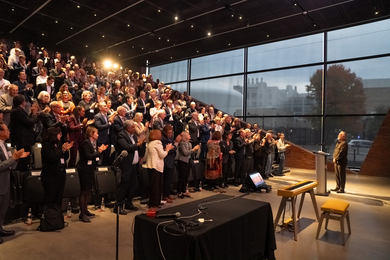
The terrorist threat to the United States may be even worse than we are being led to believe, professor of political science and associate director of the Center for International Studies, Stephen Van Evera, told a room full of students and faculty at a Jan. 11 discussion on the war on terror.
We are shifting from a very benign world to a very malignant world, said Van Evera, who spoke for two hours on the threat from terror groups like Al Qaeda as well as the disclosure responsibilities of research universities who could be working on projects with terror potential.
"The terror threat is large. I am more pessimistic than others. All the reporting I see suggests that their (Al Qaeda's) recruiting is going very well," he said.
To Van Evera, the unique danger of Al Qaeda--a terror group that has claimed the right to kill two million children--coupled with the number of poorly secured nuclear and biological weapons materials in the former Soviet Union could prove to be a catastrophic combination.
"Most of the Homeland Security program is not very serious," said Van Evera. He also questioned whether research universities should be required to disclose to the public their work on certain types of organisms or technology that could be used as mass weapons.
"If the progress of science risks bringing the democratization of the power to destroy, the public has a right to know this and form a reasoned response," said Van Evera. "We should acknowledge a duty to put the matter before the world so that all of society can together consider what response would be most appropriate."
A version of this article appeared in MIT Tech Talk on February 2, 2005 (download PDF).