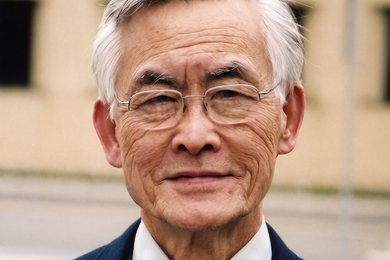
Her Royal Highness Princess Chulabhorn of Thailand recently presented MIT Professor John M. Essigmann with an award recognizing his "sustained support for the advancement of science in developing countries and his selfless dedication to teaching and research."
Essigmann received the 2004 Princess Chulabhorn Gold Medal Award at last month's Princess Chulabhorn International Science Congress in Bangkok. The congress was part of a series of events hosted by the royal family as part of the sixth cycle celebration (72nd birthday) of the princess' mother, Queen Sirikit.
The solid gold award, with an accompanying plaque, is given every five years. It honors "persons or organizations that are world-renowned and have provided outstanding support for the activities of the Chulabhorn Research Institute, as well as important support for the advancement of science in developing countries," according to a press release from the office of Thailand's prime minister.
Essigmann began working on toxicological problems affecting Thailand and the developing world as an MIT graduate student more than 30 years ago. "The developing world offers some of the most pressing and scientifically interesting problems in my field. It is a tremendous honor to receive this award from the people with whom I work and teach in Thailand," said Essigmann, who received the S.M. (1972) and Ph.D. (1976) in toxicology.
Essigmann was honored for revealing the mechanism of one of the two risk factors for liver cancer, the leading cause of cancer death in Thailand and in much of the developing world. His work revealed how the chemical substance alfatoxin contributes to the genetic changes underlying liver cancer. This toxin collaborates with hepatitis B virus, also widely present in the developing world, to lead to a high risk for liver cancer.
He was also honored for his teaching in Thailand under the Inter-university Program of the Chulabhorn Research Institute, the Asian Institute of Technology, and Mahidol University. For the last four years he and Professor Ram Sasisekharan of the Biological Engineering Division have taught summer courses in Thailand to students recruited from all over Asia.
Essigmann, the William R. (1956) and Betsy P. Leitch Professor in Residence, has taught biochemistry, bioengineering and toxicology at MIT for 23 years. He has appointments in the Biological Engineering Division and the Department of Chemistry.
A version of this article appeared in MIT Tech Talk on September 15, 2004 (download PDF).