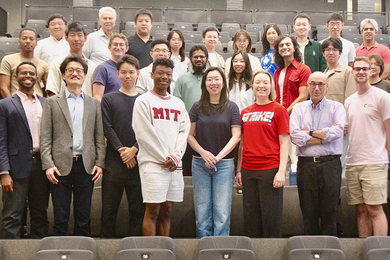
Graduate student David Berry of the Harvard-MIT Program in Health Sciences and Technology was a finalist in last week's Collegiate Inventors Competition at the National Inventors Hall of Fame.
Berry, 26, was honored for his work involving a targeted cancer treatment. He and his advisor, Robert Langer, the Germeshausen Professor in Chemical and Biomedical Engineering, came up with a new way to administer heparin, a cancer drug with harsh, often debilitating side effects. The research earned Berry a spot at the Oct. 1 competition with 13 other students from around the country: nine graduate students and five undergraduates.
"The experience was definitely interesting," said Berry, who earned the S.B. from MIT in 2000 with a major in brain and cognitive sciences. "I found people who thought differently about problems that we held in common. That will help in future research."
Berry's research involves attaching a type of polymer, developed by scientists to study the addition of DNA to living cells, to the anti-clotting drug heparin. Through this, Berry discovered a way to treat cancer cells at a much higher rate than healthy cells. Traditionally, the drug would attack both, leaving the patient debilitated.
With Berry's idea, the cancer cells began to die while the healthy tissue flourished. The treatment could help in a variety of cancers, particularly melanomas, but also cancers of the prostate, bone and brain, said Berry.
The grand prize of $50,000 went to Ozgur Sahin, 24, of Stanford University who developed a dramatically improved type of Atomic Force Microscope.
A version of this article appeared in MIT Tech Talk on October 6, 2004 (download PDF).