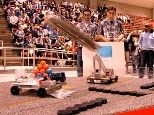
An extreme Boston driving experience unfolded at this year's 2.007 contest, named "The Big Dig" in honor of the city's sprawling Central Artery/Tunnel project. Competing machines designed by sophomores in mechanical engineering faced everything that frustrated commuters face--ramps, bridges, toll booths and piles of obstacles--and, most insidious of all, their fellow drivers.
The winner, Dean Ljubicic triumphed over his classmate Bryan Woodruff in the final round of "Big Dig" thanks to a cunning gambit: In the final moments of the contest, Ljubicic's machine, whose strength had been a Jersey-type metal barrier that blocked other machines' scoring opportunities, suddenly activated an under-street paddlewheel and spun it with mighty abandon.
Neither Woodruff nor Ljubicic's other opponents knew of the secret offensive scoring mechanism, dubbed the "spinny-thingy" by contest emcee Alex Slocum, professor of mechanical engineering.
Ljubicic later admitted his ingenuity was fueled by eagerness to travel to Japan this summer for the International Design Contest, which operates much like 2.007. Eight MIT students will participate in that contest, including Ljubicic and Woodrufff.
"The Big Dig" featured more complicated machines than in previous years as well as more scoring opportunities, which was in response to students' request, Slocum said. "We're very client-friendly, very responsive to student ideas. The future depends on our kids," he said.
A version of this article appeared in MIT Tech Talk on May 12, 2004 (download PDF).