Shedding light on why drastically restricting calorie intake prolongs life span in some organisms, MIT researchers reported in the Jan. 1 issue of Genes & Development that lowering the level of a common coenzyme activates an anti-aging gene in yeast.
Calorie restriction extends life span in a wide spectrum of organisms, and has been shown to delay the onset or reduce the incidence of many age-related diseases, including cancer and diabetes. No one is sure why it works.
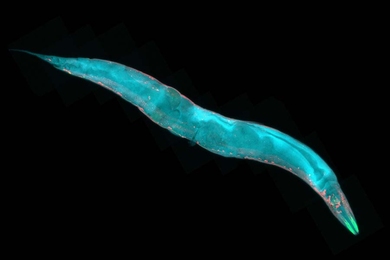
Professor of Biology Leonard P. Guarente discovered in 2000 that calorie restriction activates the silenced information regulator (SIR2) gene, which has the apparent ability to slow aging during a low-calorie diet. This gene makes a protein called Sir2, which is normally activated by the coenzyme molecule NAD. Guarente has shown that SIR2 is integrally tied to extending life span in yeast and in the roundworm. Humans carry a similar gene.
This latest study probes how Sir2 is activated by calorie restriction. The authors report that a coenzyme related to NAD, called NADH (nicotinamide adenine dinucleotide) inhibits Sir2 by blocking the action of NAD. During calorie restriction, levels of NADH decline in cells. This decrease in NADH allows NAD to better activate Sir2 and thereby extend life span.
"These findings provide a simple model for activation of Sir2 and extension of life span by calorie restriction," the authors wrote. "Our findings suggest that the NAD/NADH ratio can serve a critical regulatory function, determining the life span of yeast mother cells. A reduction in this nucleotide activates Sir2 to extend the life span in calorie restriction."
In previous research, Guarente found that rather than a slower metabolism leading to a slower rate of respiration, it turns out that respiration in yeast cells under calorie restriction goes up, not down. "A high respiration rate is intimately connected with calorie restriction in yeast," he said. "A high respiration rate activates SIR2. When respiration goes up, NADH goes down and SIR2 goes up. When SIR2 goes up, longevity happens."
In addition to Guarente, authors include Su-Ju Lin, now at the University of California at Davis; Ethan Ford, a postdoctoral associate in biology; Marcia Haigis, a postdoctoral fellow in biology; and biology graduate student Gregory B. Liszt.
This work is supported by the National Institutes of Health, the Ellison Medical Foundation, the Seaver Institute and the Howard and Linda Stern Fund.
A version of this article appeared in MIT Tech Talk on January 14, 2004.