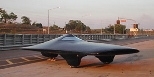
The MIT Solar Electric Vehicle team finished third in the seventh 3,000-kilometer World Solar Challenge open class race from Darwin to Adelaide, Australia.
Tesseract, the MIT car, averaged 91.2 km/hour (the fastest time ever recorded in this event by a vehicle from the United States) and achieved a top speed of 120 km/hour. The MIT car covered the course in five days, finishing 16 minutes behind the second-place car, Aurora 101 of Melbourne, Australia. Nuna II finished first--the second consecutive World Solar Challenge victory for the Nuon Solar Team of the Netherlands.
"We're really happy with our placing, and all together it was a great project," said junior Peter Augenbergs, leader of the MIT team, which consists of 10 undergraduates.
The MIT vehicle suffered flat tires on days three and four (Oct. 21-22), losing valuable time. On day four, cloudy weather was forecast and the team decided to conserve the battery by maintaining a slower pace. With the sun shining brightly at midday, the pace was increased to 105 km/hour in an attempt to make up the time.
This year's World Solar Challenge attracted 28 teams from around the world, including three others from the United States. Once the competitors leave Darwin at 8 a.m. on day one, each team decides how far to travel each day. The competitors must shut down by 5 p.m.
Fourteen cars completed the race, including one other from the United States. Ra V from Principia College in Elsah, Ill., finished sixth.
Besides Augenbergs, a mechanical engineering major, the MIT team in Australia included James Harvey, a junior in mathematics; Nathan Ickes, a graduate student in electrical engineering and computer science (EECS); Guatam Kene, a Lincoln Laboratory staff member; Christopher Pentacoff, a sophomore in aeronautics and astronautics; and Michael Seeman, a senior in EECS. The team's advisors were Andrew Heafitz (S.B. 1991) and his wife, Alison Hynd of the Office of Academic Services; and Uldis Augenbergs, Peter's father.
A version of this article appeared in MIT Tech Talk on October 29, 2003.