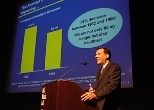
Health care costs are rising worldwide at rates that alarm governments, businesses and individuals, acknowledged Daniel Vasella, chairman and CEO of Novartis AG, a global pharmaceutical corporation. Prescription drugs, however, are a small portion of medical expenditures; the real cost-drivers are hospitals and an aging population, he told an MIT audience at the Sept. 18 Industry Leaders in Technology and Management lecture.
"Health care expenditures as a percent of GDP have grown in most countries," Vasella said. His talk was titled "Pharmaceuticals: Just a Cost Factor?" and sponsored by MIT's Industrial Liaison Program and the Center for Technology, Policy and Industrial Development.
"In the U.S. in 2001, $1.4 trillion was spent overall on health care--and drugs made up 10 percent of that. If you look at the press coverage, 90 percent is focusing on the 10 percent. Yet most countries have hospital costs around 40 to 50 percent with very little focus on managing these costs," he said.
Drug companies are an easy target, Vasella said, because they tend to be international, are remote from patients, and publicly state profits. People (and governments) tend to like their own doctors and hospitals, so are they less apt to question fees. Prescription drug expenditures total about 1.7 percent of the GDP, he said, noting that Americans spend more on videos and music than on medicines.
Public health care discussions often assume that costs can be contained and perhaps even reduced. "We have to be aware that that is an illusion," said Vasella who holds an M.D. "With an increase in numbers of seniors and a decrease in the birth rates in all industrialized countries, the outcome is undeniable. There will be more need and it's impossible to reduce health care expenditures unless we ration care. The fact is that costs will increase--the question is, how much?"
Health care expenditures increase with age and then escalate more sharply at age 50-55, costing about $3,500 a year per person at their peak, he said. The world population is aging and, in North America, the percentage of people over 60 is expected to grow from 16 percent in 1995 to 30 percent in 2040.
Pharmaceuticals are not just a cost factor, Vasella said. The industry has contributed to the worldwide increase in health and quality of life, including rising life expectancy and decreasing disability, he said.
Vasella, who led the merger of Sandoz and Ciba-Geigy, strengthened the company's research capacity by establishing a Genomics Institute and by moving research headquarters to a 240,000-square-foot facility in the former Necco factory adjacent to MIT. The company projects 2003 sales of $24 billion.
Vasella concluded the talk by quoting a Mongolian proverb: "Being sick, one thinks of the cure. Being healthy, one thinks of the cost."
A version of this article appeared in MIT Tech Talk on October 1, 2003.