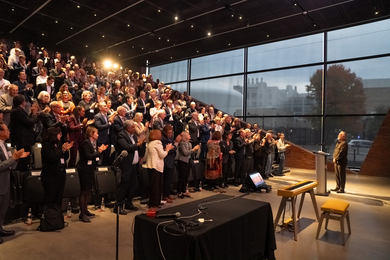
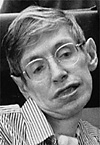
In a live broadcast from England to several classrooms at MIT, physicist Stephen Hawking described scientists' search for a complete theory of the universe, ultimately concluding that "maybe [such a theory] isn't possible."
"Some people will be very [disappointed] if there is not an ultimate theory," Hawking said. "I belong to that camp, but I have changed my mind." We will "always have the challenge of new discovery. Without it, we will stagnate. Long may the search continue."
The broadcast, which was marred by technical problems with video and especially audio, was also available as a webcast. It was sponsored by the Cambridge-MIT Institute (CMI), a three-year-old strategic alliance between the University of Cambridge in England and MIT. CMI's mission is to deliver education and research that enhance the competitiveness of U.K. business.
Hawking essentially gave a brief history of particle physics, focusing on the key scientists and theories in the field from Aristotle to Stephen Weinberg (a Nobel laureate born in 1933).
The Maxwell and Dirac equations, for example, "govern most of physics and all of chemistry and biology," Hawking said. "So in principle we should be able to predict human behavior, though I can't say I've had much success myself," he said to chuckles from the audience.
The human brain contains too many particles for us to do the equations necessary to predict behavior, he continued. We may someday be able to predict the behavior of the nematode worm, however, "which may be comforting."
All of the theories developed so far to explain the universe "are both inconsistent or incomplete," Hawking said. He went on to discuss why it may not be possible to develop one complete theory of the universe, basing his argument on the work of Kurt Gödel. The Czech mathematician showed that within any branch of mathematics, some propositions cannot be proven true or false.
Hawking, author of the best-seller "A Brief History of Time," is the Lucasian Professor of Mathematics at the University of Cambridge. For more information on the Cambridge-MIT Institute, click here.
A version of this article appeared in MIT Tech Talk on January 29, 2003.