Skip to content ↓

High school students, teachers bust dust

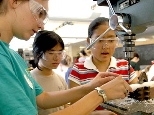
Joelle Brichard, a resident tutor and MIT student, assists Women's Technology Program high school students Helen Deng San Francisco, center, and Julia Chang of Torrance, Calif., as they build a part for a motor.
Caption:
Joelle Brichard, a resident tutor and MIT student, assists Women's Technology Program high school students Helen Deng San Francisco, center, and Julia Chang of Torrance, Calif., as they build a part for a motor.
Credits:
Donna Coveney

Forty high-school women and six science teachers learned about the physics and design of the hand-held vacuum, then built and tested their own motors in an MIT class led by Associate Professor Steven Leeb of the Department of Electrical Engineering and Computer Science (EECS).

The course, dubbed "Dustbusting by Design: Applying the Engineering Design Process," brought together participants in two MIT summer programs.

The Women's Technology Program is a four-week summer residence program designed to introduce women high-school students to the fields of electrical engineering and computer science. Participants are selected from a nationwide applicant pool of outstanding female high-school juniors.

The program is sponsored by EECS and the School of Engineering at MIT.

The Science Teachers Enrichment Program (STEP) brings middle- and high-school science teachers to the campus for a weeklong program focused on materials science and engineering and on the engineering design process. Among other things, STEP helps teachers create classroom modules on engineering that comply with state learning standards.

STEP is run by MIT's Center for Materials Science and Engineering, part of a nationwide network of Materials Research Science and Engineering Centers funded by the National Science Foundation.
Related Links

Related Topics

More MIT News

Rich Nielsen, Volha Charnysh, Kevin Dorst, and Emily Richmond Pollock seated at a table, talking

Building a scholarly community

The SHASS Faculty Fellows Program, administered by the MIT Human Insight Collaborative, is fostering new research projects and creating space for supportive and interdisciplinary discussion.

Read full story

Globular blue and white orbs "examining" single-stranded RNA products and marking them with green checks or red x's

Why are some bacterial genes high in purines?

In certain species of bacteria, the answer lies in shielding RNA transcripts from a quality-control factor called Rho. Understanding the requirements for expressible sequences is critical for expression engineering of therapeutic agents.

Read full story