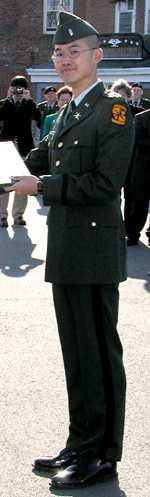
After Jimmy Wu received the S.B. in mechanical engineering last June, he planned to pursue a career in the Midwest and joined a National Guard unit in McConnelsville, Ohio.
Second Lt. Wu of the 2nd-174th Air Defense Artillery Battalion has now put his civilian career plans on hold. The unit was activated on March 15.
While he did not anticipate mobilization, Wu believes in the mission.
"Operation Enduring Freedom has liberated Afghanistan and [Operation Iraqi Freedom] will definitely liberate Iraq," he said. "These are good things. I am grateful for the opportunity to participate."
In a letter to the MIT News Office, Wu described his platoon's role in combat.
"Our mission is to shoot down enemy aircraft, UAVs [unmanned aerial vehicles] and cruise missiles in defense of rear area assets," he said. "We have not received a definite word on where we are going, but we are heading down to Fort Bliss, Texas to train up as per our mobilization plan."
Wu, who received his commission through the MIT ROTC program, actually had only 12 days to consider civilian plans. Shortly after graduation, he attended a five-month air defense artillery officer basic course that ended on Feb. 6. He received word that the outfit would be mobilized on Feb. 18 and lived in the armory while awaiting reassignment.
As a Stinger platoon leader, Wu's primary responsibility is positioning missile firing teams "to protect static assets during daylight," he wrote. "As a platoon leader in general, I also supervise day-to-day activities such as equipment maintenance, battle drills and counseling subordinate leaders."
Wu, who comes from Acton, Mass., continued, "Obviously, this is not something most people volunteer for. It's the contract I signed, though. I will help in keeping these guys alive."
A version of this article appeared in MIT Tech Talk on April 2, 2003.