Skip to content ↓

64 complete MITE2S program

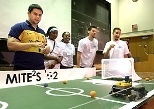
Teaching assistant Guillermo Chicas (far left) watches the winning robot        in action during the 2002 MITE2S robotics design competition. Team members who designed and built it were (left to right) Cherelle Walls, Oyinade Aderibigbe, Aaron Arizpe and Daniel Chaparro.
Caption:
Teaching assistant Guillermo Chicas (far left) watches the winning robot in action during the 2002 MITE2S robotics design competition. Team members who designed and built it were (left to right) Cherelle Walls, Oyinade Aderibigbe, Aaron Arizpe and Daniel Chaparro.
Credits:
Photo / Justin Allardyce Knight

Sixty-four high school juniors from 25 states completed a rigorous six-week regimen in the MITE2S (Minority Introduction to Engineering, Entrepreneurship and Science) program on Aug. 2, many of them hoping to return in a year as members of MIT's Class of 2007.

The 32 male and 32 female students were participating in the 28th session of the summer enrichment program for students from underrepresented minority groups. The program has attracted 1,340 students from coast to coast since it was inaugurated in 1975.

The students took courses in calculus, physics, biochemistry and chemistry, humanities, entrepreneurship, programming and engineering design. One of the program's highlights is the annual robot design contest, won this year by Cherelle Walls, Oyinade Aderibigbe, Aaron Arizpe and Daniel Chaparro on July 26.

If this year's group is typical, about 48 students will apply to MIT and 45 will be accepted. Of these, 20 to 25 will matriculate while most of the others will major in engineering and science at other elite universities.

A version of this article appeared in MIT Tech Talk on August 14, 2002.
Related Topics

More MIT News

Globular blue and white orbs "examining" single-stranded RNA products and marking them with green checks or red x's

Why are some bacterial genes high in purines?

In certain species of bacteria, the answer lies in shielding RNA transcripts from a quality-control factor called Rho. Understanding the requirements for expressible sequences is critical for expression engineering of therapeutic agents.

Read full story

Rich Nielsen, Volha Charnysh, Kevin Dorst, and Emily Richmond Pollock seated at a table, talking

Building a scholarly community

The SHASS Faculty Fellows Program, administered by the MIT Human Insight Collaborative, is fostering new research projects and creating space for supportive and interdisciplinary discussion.

Read full story