The goal of the theoretical physicist is to create such precise, elegant theories that you can use them to explain -- as author Douglas Adams might put it -- life, the universe and everything.
For a theoretical physicist, actually measuring anything through experimentation is a compromise. In this year's Pappalardo Distinguished Lecture in Physics, world-famous theoretical physicist Frank Wilczek, the Herman Feshbach Professor of Physics at MIT, will show that the number of measurements we need to explain the world are very limited.
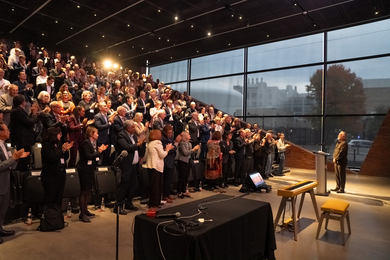
This year's lecture from the series named in honor of Neil and Jane Pappalardo will take place tomorrow (Thursday, April 26) at 4:15pm in Rm 10-250.
"I want to give a sense of how far physics has evolved by reducing the laws of physics to a few that are very powerful," Professor Wilczek said. These theories are so powerful that with a very small number of inputs -- specifically, six -- the fundamental rules governing all matter as we know it can be formulated precisely.
For instance, by combining appropriate powers of three parameters -- the speed of light, Planck's constant and gravity -- one can reproduce any unit of measure needed in the description of the physical world. Following from quantum chromodynamics and Einstein's theory of relativity, the proton's mass can be derived in terms of energy, knocking mass out of the lineup of essential measurements.
In his talk, titled "The World's Numerical Recipe," Professor Wilczek will describe how "we can cook up a superb model of ordinary matter (allowing a very liberal definition of 'ordinary') using four numerical parameters as ingredients. A passable model needs only two. After adding another two ingredients for six total, we can serve up astrophysics."
Each of these numbers has profound physical meaning, he said. Moving toward a unified theory of fundamental physics by "trying to reduce the number from six to five is what a lot of us are trying to do. Reducing the count by one number, at this point, would be a major event in physics."
A version of this article appeared in MIT Tech Talk on April 25, 2001.