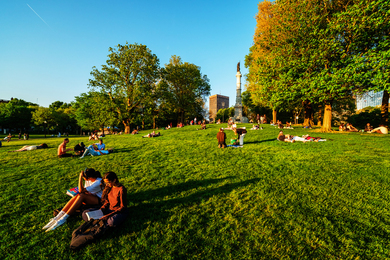
CAMBRIDGE, Mass. -- MIT's award-winning sukkah, a temporary structure rebuilt annually in the fall on Kresge Oval at the MIT campus, stands ready to welcome people for dining and socializing during Sukkot, the week-long Jewish harvest festival.
Designed by two women in the MIT department of architecture in 1991, the MIT sukkah is uniquely whimsical in its multi-colored, intricate latticework. It also adheres to ancient rabbinical building instructions, including the requirement that the roof must be fifty percent uncovered and made of vegetation through which one may always see the stars.
Miriam Rosenblum, director of MIT Hillel, has noted that while the MIT sukkah has taken the basic requirements for a sukkah, it has become an artistically distinctive structure in the use of color, materials, entryway and atrium roof. The pomegranate-shaped details also draw on the harvest holiday's traditions.
The sukkah is traditonally erected as part of the obervance of Sukkot, the eight-day Jewish holiday to celebrate the harvest. Sukkot begins shortly after the end of Yom Kippur and ends with Simchat Torah. This year, the festival of Sukkot begins at sundown on Friday September 24th and runs through sundown on October 2nd.
The MIT sukkah won the Elie Wiesel Award for Jewish Arts and Humanities in 1993. The award was presented to MIT Hillel by Elie Wiesel.