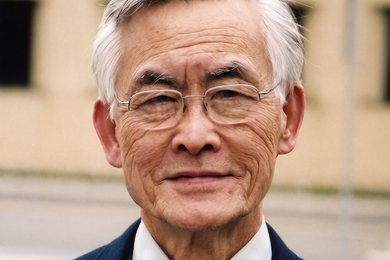
A new fellowship in the Department of Earth, Atmospheric and Planetary Sciences (EAPS) has been established by Warren G. Klein's family, many of whom were thanked at a September 22 ceremony.
Mr. Klein was a distinguished employee of the US Treasury Department and an amateur meteorologist before his death from cancer in 1997. The Klein family established an endowed fellowship in meteorology to allow future graduate students to follow their own passion for the field.
At last week's ceremony last Wednesday, Mrs. Ruth Klein, his mother, received a commemorative plaque, and reflections on Mr. Klein's life were delivered by his brothers, Dr. Gordon Klein and Douglas Klein. His niece, Adrienne Klein, performed a violin solo.
"We are deeply grateful to the Klein family for choosing to remember Warren in this way," said Professor Ronald G. Prinn, head of EAPS. "This fellowship will help an unending series of brilliant young people to work on unsolved problems of our weather."
Graduate student Robert Korty is the first recipient of a Warren G. Klein Fellowship. A 1999 graduate of the University of Virginia, he is interested in the general areas of tropical meteorology and numerical weather prediction.
A version of this article appeared in MIT Tech Talk on September 29, 1999.