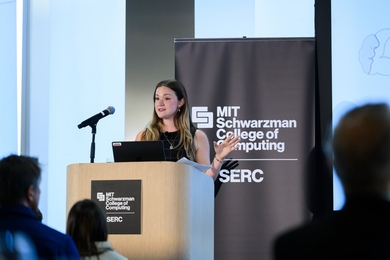
Brit d'Arbeloff (SM 1961), the first woman to receive a mechanical engineering degree from Stanford University, will deliver the Department of Mechanical Engineering Distinguished Alumni Lecture at 4pm Thursday, Feb. 18 in Rm 1-390.
In her presentation, "Girls from the LA Office: Women in Technology," she will talk about her experience as a woman working in the engineering field.
Ms. d'Arbeloff graduated first in her engineering class in 1957 and was elected to Phi Beta Kappa before going into the aerospace industry. She worked on the Redstone Missile nose cone recovery package and was present at Sputnik's launch in October 1957.
During her years in graduate school at MIT and afterward, she worked full-time at Northern Research and Engineering (NREC), where she analyzed heating and cooling requirements for high-speed aircraft, moon launches and space travel. Her "Heat Transfer in a Fully Ionized Gas" was published by the Navy, and "Design of Fin-Tube Heat Exchangers" was published by NREC.
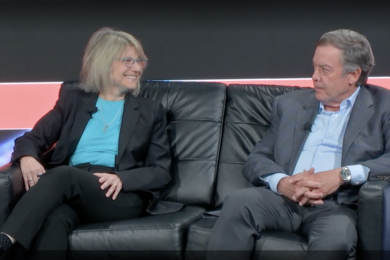
Ms. d'Arbeloff took a 10-year hiatus from engineering to raise "four children, a dog, three cats, an enormous white rabbit, two hamsters, two robins and a squirrel," she said. She then stepped back into the technical world as a programmer and systems analyst specializing in manufacturing software. In 1985, she became vice president and treasurer of a clothing store partly owned by her and her husband, Alex d'Arbeloff, who is currently chairman of the MIT Corporation. Ms. d'Arbeloff has written five unpublished novels.
Her talk will be the third of this year's Distinguished Alumni Lectures, a series established by the Department of Mechanical Engineering in 1991. Generally, three or four alumni/ae are brought in each year for two-day campus visits to meet with the department head, selected faculty and students. The program allows eminent alumni/ae to remain actively involved with the department, and creates a means for students to interact with successful graduates.
A version of this article appeared in MIT Tech Talk on February 10, 1999.