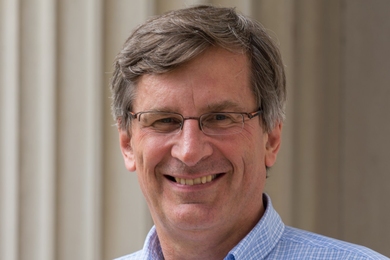
A memorial service will be held from 7-9pm tomorrow (March 12) in the MIT Chapel for Professor David N. Hume of chemistry, who retired in 1980 after 33 years at MIT. Professor Hume, 80, died on March 2 at the Kathryn Barton Nursing Home in Wayland after a long illness.
Professor Hume joined MIT in 1947 as an assistant professor and was promoted to associate professor in 1950. He became a full professor in 1959.
A native of Vancouver, he was raised in Los Angeles and attended Los Angeles City College before receiving the AB from UCLA in 1939. He earned the MA from UCLA the next year and PhD from the University of Minnesota in 1943.
During World War II, Professor Hume worked on the Manhattan Project at the University of Chicago and at the Clinton Laboratories in Oak Ridge, TN. At the end of the war, he was the head of analytical research and service at the Oak Ridge plutonium plant. Before coming to MIT, he was an assistant professor at the University of Kansas.
Professor Hume was a Guggenheim Fellow at the University of Denmark in 1954-55 and received the Fisher Award in analytical chemistry in 1963. He was a member of the American Chemical Society, Sigma XI and Phi Lambda Epsilon. He also was a fellow of the American Academy of Arts and Sciences.
Professor Hume is survived by his wife of 57 years, the former Aloyse Bottenwiser of Wellesley Hills; a son, Professor Robert D. Hume of State College, PA; and a daughter, Rebecca "Ginny" Fitzgerald of Bridgewater, MA.
A version of this article appeared in MIT Tech Talk on March 11, 1998.