What do potato chips, cork and plastic foams have in common? All are highly porous materials with a honeycomb-like cellular structure.
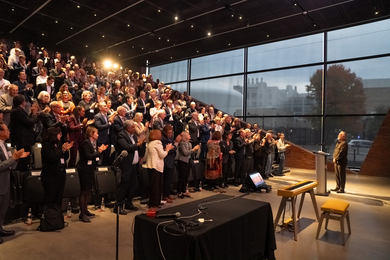
Such materials were the subject of Professor Lorna Gibson's talk during MIT's annual Science and Engineering Program for Middle and High School Teachers. "My research focuses on the mechanical behavior of these materials," explained Dr. Gibson, the Matoula S. Salapatas Professor of Materials Science and Engineering. To that end, she develops mathematical models of cellular materials to predict, among other things, how their cell walls deform under pressure and how they fail.
The models have a number of applications. For example, they can be used to identify the best foam to use inside "sandwich" structures such as skis and the flooring panels in airplanes, and in safety devices such as helmets.
Professor Gibson and colleagues are also working to understand changes in density and strength of trabecular bone, the foam-like material at the ends of long bones and in vertebrae. "People with osteo-porosis have increased risk of hip and vertebral fractures which result from a reduction in the mass of trabecular bone in these areas," she explained.
Her work also has applications in tissue engineering. For example, Professor Ioannis Yannas of mechanical engineering and materials science and engineering has developed an "artificial skin" for burn victims and others in which skin cells implanted onto a porous polymer scaffold grow into a new tissue.
"The scaffold looks an awful lot like the foam materials I've been talking about," Professor Gibson said. As a result, "we're looking at the contractile forces the [skin] cells apply to the scaffold to understand how the scaffold mediates healing and why it doesn't cause as much scar tissue" as an untreated area.
A version of this article appeared in MIT Tech Talk on July 15, 1998.