Underwater robots developed at MIT are helping scientists probe mysteries of the ocean from its influence on climate change to one of its denizens: the giant squid.
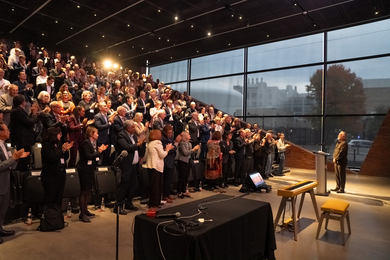
About 30 science teachers heard about these and other applications of autonomous underwater vehicles (AUVs) in a talk by James Bellingham, director of MIT Sea Grant's AUV Lab. At the same session, one of the roughly five-foot-long AUVs was the focus of a "show and tell" by Robert Grieve, field operations manager for the lab's fleet of five robots.
Recent expeditions include last year's search for the giant squid (which the scientists didn't find), and a trip to the Labrador Sea to study ocean circulation. The latter involved tests of a new underwater docking system for the robots that will allow the scientists to leave them for extended periods of time to collect data. "We're still developing this. It will be another five years or so before the system will be routinely used," said Dr. Bellingham.
"The ocean is important to understanding climate," he said. Dr. Bellingham explained how AUVs are the "sensing tip" of a complicated network of computers the scientists are developing to help determine the impact of the ocean on climate change. The data the robots collect will be used in computer models for climate change.
A version of this article appeared in MIT Tech Talk on July 15, 1998.