SENIORS CREATE ELECTRONIC NEWSPAPER
The Silver Stringers are a group of about 20 senior citizens from Melrose who are defying stereotypes about difficulties that people in their 60s, 70s or even 80s have in going online.
These seniors have joined forces with researchers at the Media Laboratory's News in the Future (NIF) consortium to enhance the use of the Internet for individual communities around the world. The result has been the creation of an electronic newspaper, The Melrose Mirror.
"One of the Media Lab's goals is to facilitate the use of computers and the Internet at the community level, creating a community within a community," said Jack Driscoll, editor-in-residence at the Media Lab and the Silver Stringers' advisor. "While watching the group's success and analyzing its stumbling blocks, we are attempting to develop new software for online community newsletters."
Mr. Driscoll, Walter Bender (director of the NIF consortium), graduate student Marko Turpeinen and administrative assistant Rebecca Prendergast have been working with the Stringers on the software. They are also adapting several new ideas in applications hardware. Visit The Melrose Mirror at <http://silverstringer.media.mit.edu/ss/html>.
(Source: Frames, a publication of the MIT Media Laboratory.)
DETECTING CRACKS IN CONCRETE STRUCTURES
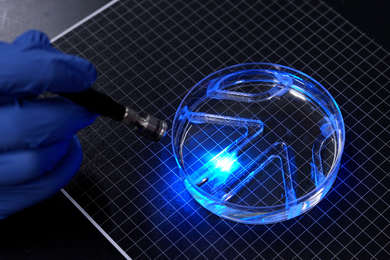
MIT researchers and colleagues are designing new optical fiber sensors to detect cracks in concrete structures from bridges to the protective walls surrounding hazardous-waste dumps.
In a bridge, the fibers would be embedded in a plastic sheath and glued securely to the bottom of the bridge deck. When a crack forms across a fiber, the fiber bends, causing a sudden loss in signal as some energy escapes from the fiber core.
"To detect the cracks, the back-scattered signal is monitored. Knowing the speed of light inside the fiber, we can calculate where the signal drop occurred, and from the intensity of the drop, we should be able to tell how much a crack has opened up," said Professor Christopher Leung of the Department of Civil and Environmental Engineering. Professor Leung's group and colleagues at Brown University are developing a model to describe signal loss vs. crack opening.
Another potential application is to guard against leaks around hazardous-waste dumps. Sometimes wastes are packed into containers that gradually deteriorate and allow contaminants to percolate through allegedly protective concrete barriers surrounding the site. A long-lived, sturdy sensor inserted into the dump's protective wall will give the location of any crack that forms in that wall, so the opening can be regrouted. The work is funded by the DOE through the Idaho National Engineering Lab/University Research Consortium Program.
(Source: Civil and Environmental Engineering at MIT)
A version of this article appeared in MIT Tech Talk on March 19, 1997.