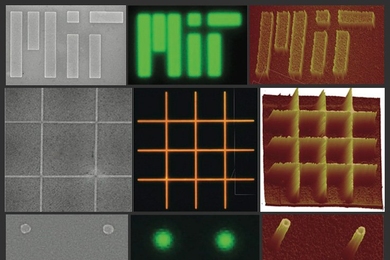
Patterning defect-free nanocrystal films with nanometer resolution
New process developed at MIT could enable better LED displays, solar cells and biosensors — and foster basic physics research.
New process developed at MIT could enable better LED displays, solar cells and biosensors — and foster basic physics research.
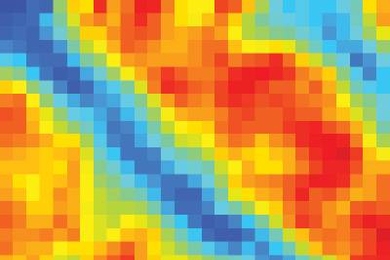
New findings show that the material beneath the thin carbon sheets determines how they react chemically and electrically.
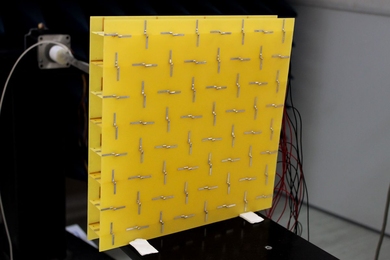
A new ‘metamaterial’ prevents electromagnetic waves from reflecting backward, pointing the way toward computer chips that move data with light.

MIT physicist among nine inaugural winners of prize awarded by Russia’s Milner Foundation.

Long-sought goal for quantum devices — the ability to transmit single photons while blocking multiple photons — is finally achieved.
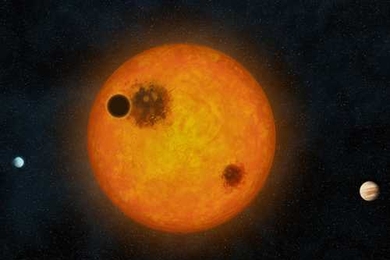
Researchers measure the orientation of a multiplanet system and find it very similar to our own solar system.

Jarillo-Herrero, Lu, Pathak, Sinha and Thaler among 96 winners.
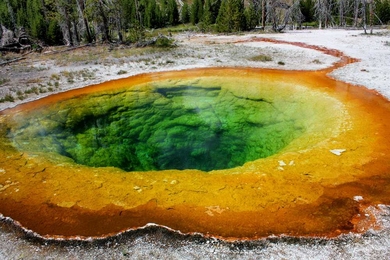
Tiny cylinders help reveal how natural-light-harvesting antennae collect light with exceptional efficiency.

Dozens of MIT physicists were part of the team that found what might be the Higgs boson. What does their discovery mean, and what’s next for particle physics?
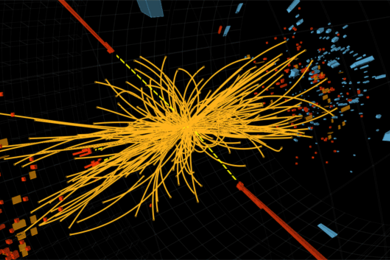
Dozens of MIT researchers contribute to breakthrough in particle physics.
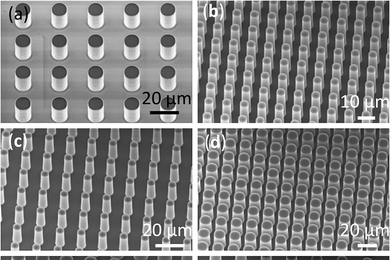
Heat transfer in everything from computer chips to powerplants could be improved through new analysis of surface textures.
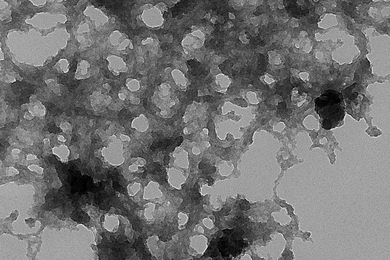
Multidisciplinary team develops mathematical approach that could help in simulating materials for solar cells and LEDs.
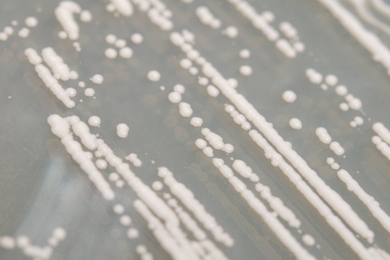
Findings could help fishery and wildlife managers monitor their stocks before disaster strikes.