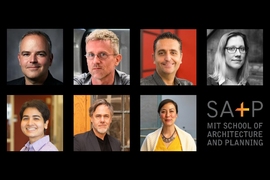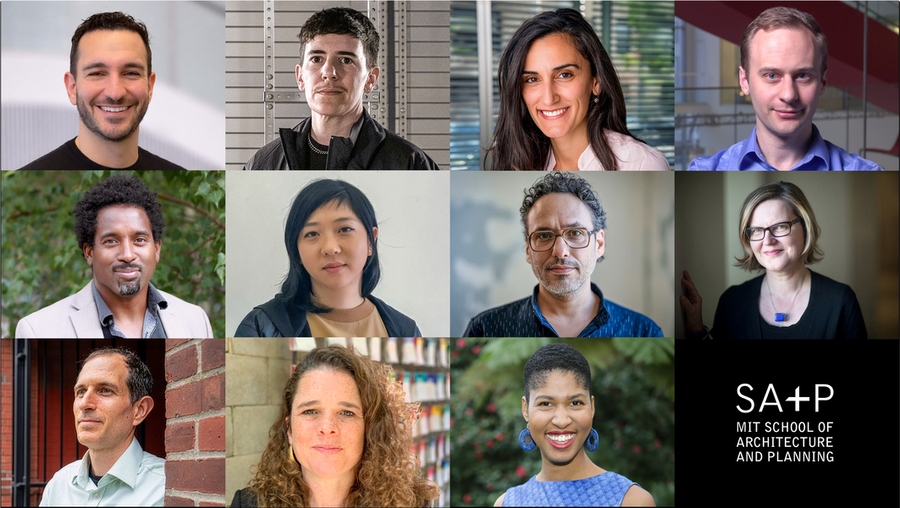
The MIT School of Architecture and Planning recognized 11 faculty members with promotions for their significant contributions to the school, effective July 1, 2026. Four faculty promotions are in the Department of Architecture, three are in the Department of Urban Studies and Planning (DUSP), and four are in the program in Media Arts and Sciences.
“These individuals offer the MIT community creativity, knowledge, and scholarship that is exhilarating,” says Hashim Sarkis, dean of the School of Architecture and Planning. “Collectively, they add considerable strength to our faculty and research capacity.”
Department of Architecture
Xavi Aguirre has been promoted to associate professor without tenure. Aguirre is also director of DIS-ASSEMBLIES LAB, where his work focuses on learning from and designing for when architectures come apart. Through building (and unbuilding) projects, product development, and research, he considers our relationship to material and commodity circulations, both technically and culturally. Aguirre’s work has been commissioned by the Carnegie Museum of Art, the Industry Opera Co., MOCA Geffen, and Dartmouth College, among others. He is the is founder/director of the design studio stock-a-studio.
Rosalyne Shieh has been promoted to associate professor without tenure. Shieh is an architect based in Cambridge, Massachusetts, and Kaohsiung, Taiwan. Her work engages places at the intersection of material culture, oral history, and postcolonial identity; architectural projects are processes for thinking-with-site, and design is the extension and invention from the ordinary. Shieh has worked for Stan Allen Architect, ARO, and Abalos & Herreros, and was formerly co-director of the collaborative practice Schaum/Shieh. She is co-author of “Blanking: An Annotated Archive of Projects and Thoughts on Architecture” (Park Books, 2025).
Nida Sinnokrot has been promoted to associate professor with tenure. Sinnokrot is an artist and educator whose work explores how various forms of power and bias are embedded in dominant narrative structures and attendant articulations of time and space. Working across film, video, photography, sculpture, installation, and agriculture, Sinnokrot seeks to expose and cannibalize — through tactile, tactical, and material acts of technical and conceptual detournement — various technologies of control that give rise to shifting social, political, and environmental instabilities. He is a co-founder of Sakiya, an international residency program and research platform in the West Bank village of Ein Qinya. His recent solo shows include “Nida Sinnokrot” at Kunst-Station Sankt Peter, Cologne (2019-20) and “Expand Extract Repent Repeat” at Carlier | Gebauer in Berlin (2018-19).
Kristel Smentek has been promoted to full professor. Smentek is a historian of 18-century European art with specializations in histories of the graphic and decorative arts in their transcultural contexts, the history of collecting, and European encounters with Asia. Smentek has received fellowships and awards from a host of organizations including the National Endowment for the Humanities, the American Council of Learned Societies, and the Andrew W. Mellon Foundation. In her current book project, “Disorient: Arts from China in Eighteenth-Century France,” Smentek analyzes European engagements with Asian imports in the 18th century and their impact on continental art and aesthetic theory. Smentek is also active as a curator. Most recently, she was co-curator of the exhibition “Dare to Know: Prints and Drawings in the Age of Enlightenment,” which examined the constitutive role of works on paper in the propagation of European Enlightenment ideals and blind spots, and a contributor to and co-editor of its accompanying catalog (Harvard Art Museums, 2022).
Department of Urban Studies and Planning
Jason Jackson has been promoted to associate professor with tenure. Jackson is an associate professor of political economy and director of the Political Economy Lab. His research focuses on the relationship between states and markets, particularly the role of economic ideas and moral beliefs in shaping market institutions under modern capitalism. Empirically, his work focuses on contexts ranging from the role of economic nationalism in industrial development to the rise of the digital “platform” economy and urban mobility markets in contemporary cities in Africa, Asia, and the Americas. Jackson is the author of “Traders, Speculators and Captains of Industry: How Capitalist Legitimacy Shaped Foreign Investment Policy in India” (Harvard University Press, 2025) and “Constructing Economic Nationalisms in Brazil and India” (Cambridge University Press, 2026).
Justin Steil has been promoted to full professor. Steil is professor of law and urban planning and a Margaret MacVicar Faculty Fellow. As Academic Curriculum Committee faculty chair, he leads a new faculty committee for the MIT Center for Real Estate and the Master of Science in Real Estate Development program, bringing together faculty from across the school to shape the future of the curriculum. As a lawyer, a paramedic, and an urban planner, Steil’s research focuses on spatial dimensions of inequality. Steil analyzes spatial inequality in the domains of environmental justice, housing and land use policies, and health equity, among others. Recent research focuses on the effects of neighborhoods on health, on mobility risk, and on the role of emergency medical services in advancing health equity.
Sarah Williams has been promoted to full professor. Williams, the Norman B. (1938) and Muriel Leventhal professor of architecture and planning, is the director of the Civic Data Design Lab and director of the Norman B. Leventhal Center for Advanced Urbanism. Williams combines her training in computation and design to create communication strategies that expose urban policy issues to broad audiences and create civic change, a process she calls Data Action. Williams is co-founder and developer of Envelope.city, a web-based software product that visualizes and allows users to modify zoning in New York City. In her book “Data Action: Using Data for Public Good” (The MIT Press, 2022), Williams provides a guide for working with data in more ethical and responsible ways.
Program in Media Arts and Sciences
Fadel Adib has been promoted to full professor. Founding director of the Signal Kinetics research group, Adib holds a joint appointment in the Department of Electrical Engineering and Computer Science. He has spent his career expanding the frontiers of wireless sensing, developing technologies that locate hidden objects, navigate indoor environments, and detect contaminants in food and water. Since receiving tenure in 2022, his group has integrated generative AI with wireless vision, enabling robots to interact with objects blocked entirely from view. His spinoff, Cartesian Systems, is now deployed in more than 700 stores across 55 countries. Adib was named a Young Global Leader by the World Economic Forum in 2024 and received the Great Arab Minds Award in Engineering and Technology in 2023.
Canan Dağdeviren has been promoted to associate professor with tenure. Dağdeviren is the founder and director of the Conformable Decoders research group and has built a research program around the idea that the human body continuously produces coded physical patterns — through motion, pressure, sound, electrical activity, and biochemical change — that carefully designed materials and devices can decode to improve human health. Her group develops technologies that bend and conform to the body, including a wearable ultrasound breast patch for more frequent and accessible cancer screening, and ImPULS, an implantable piezoelectric ultrasound stimulator for deep brain stimulation. Dağdeviren also serves as faculty lead of the MIT Media Lab's WHx Women's Health Program, which this year became an official program of the MIT HEALS Initiative — a significant institutional recognition of her commitment to addressing longstanding gaps in women's health through bold, cross-disciplinary research.
Kevin Esvelt has been promoted to associate professor with tenure. Esvelt, who leads the Sculpting Evolution research group, invents new ways to study and influence the evolution of ecosystems, addressing some of humanity's most difficult ecological and public health challenges with a commitment to openness and humility. His community-driven “Mice Against Ticks” project, featured in a landmark 60 Minutes segment last year, is engineering Lyme-immune mice on Nantucket, Massachusetts to stop the disease at its source. He has also emerged as one of the nation's leading voices on biosecurity, with research exposing the dangers of AI systems capable of generating biological weapons information — highlighted by The New York Times in April — and a Policy Forum piece in Science on mirror life that has advanced critical public conversations about the governance of emerging biotechnologies. His work on CRISPR gene drives, RoboPace, and “daisy drives” has reshaped global conversations about the future of evolution.
Danielle Wood has been promoted to associate professor with tenure. Wood, the founding director of the Space Enabled research group, has spent her career proving that satellite technology can be a powerful instrument for justice on earth. Holding a joint appointment in the Department of Aeronautics and Astronautics and serving as MIT's faculty lead for African and African Diaspora Studies, Wood has developed the EVDT framework — Environment-Vulnerability-Decision-Technology — a systems approach applied successfully in countries including Ghana, Angola, and Brazil. Her impact extends well beyond the MIT Media Lab: She received the 2026 Paul Gray Faculty Award for Public Service and the 2025 Letten Prize, and has served multiple times as a private sector advisor to the U.S. Delegation to the United Nations Committee on the Peaceful Uses of Outer Space.