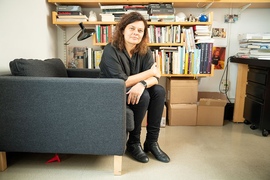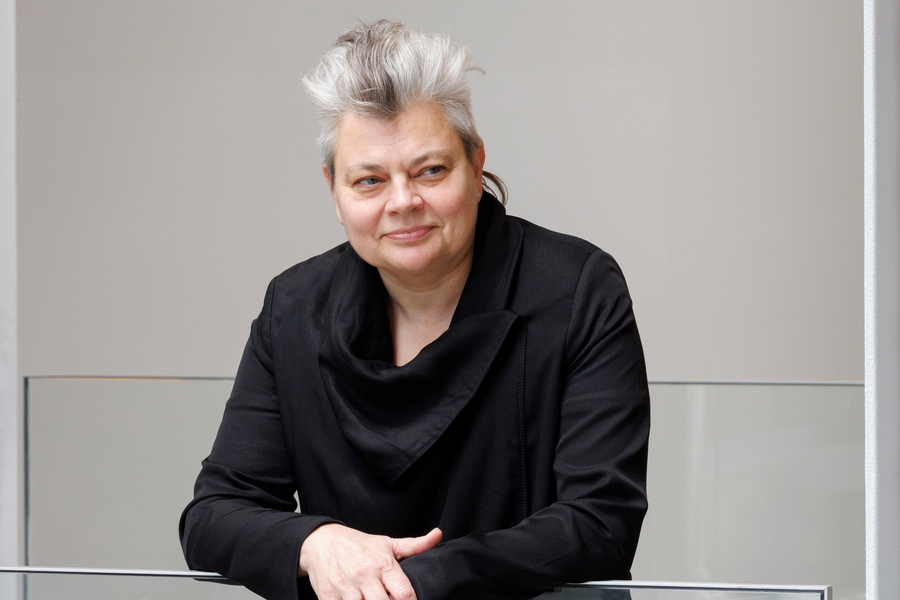
Ana Miljački looks back at her nearly 20 years teaching in the MIT Department of Architecture and says that one thing was perfectly clear to her on arrival: the caliber of her students.
“I appreciated immediately that these were students comfortable being at the edge of the discipline, eager to push and transform it,” says Miljački. “They didn’t necessarily seek the spotlight, but understood the value of participating in important transformations.”
Transformations are forthcoming for Miljački, the Francis White Davis Professor of Architecture: She became head of the Department of Architecture for the School of Architecture and Planning (SA+P) on July 1, and the architecture department itself will move to the Metropolitan Storage Warehouse (the Met) in late summer.
Miljački takes the reins from Nicholas de Monchaux, the Weber-Shaughness Professor, who helped significantly advance the department’s commitment to studio-based research and impact, particularly around climate resilience and sustainability. He also helped catalyze and deepen the ongoing exchange between MIT and Tuskegee University rooted in the legacy of Robert R. Taylor.
In announcing Miljački’s new role, SA+P Dean Hashim Sarkis noted that Miljački has directed two of the department’s specialized graduate degree programs: the Master of Science in Architecture Studies program (2023-25) and the Master of Architecture program (2016-20), and played a central role in shaping the department’s academic and pedagogical culture.
“Ana has led many of the department’s academic programs with dedication, advancing experimentation in pedagogy, encouraging critical thinking, and linking research and learning in a manner that is distinctly MIT,” says Sarkis. “She teaches history, theory, and design, and her work is internationally recognized for its contributions to architectural discourse, pedagogy, and institutional critique. I look forward to seeing her bring this vision to the department as a whole.”
Building a career at MIT
Having taught at Columbia University, City College in New York, and Harvard University Graduate School of Design, Miljački quickly recognized the value of being at MIT as a young faculty member. She found generous support for her research — humanities-driven historical scholarship, criticism, and her curatorial work.
“When junior faculty are supported to produce their own work, they also support students who are helping them,” says Miljački. “That is not something I had encountered until coming to MIT. The way the Institute has historically treated young faculty is unmatched by any other institution.”
She launched a distinguished career as a scholar and curator examining the organization, politics, authorship, and cultural production of architecture from Cold War-era Eastern Europe to contemporary architectural practice. In 2014, she co-curated the U.S. Pavillion at the Venice Architecture Biennale, which featured the exhibition “OfficeUS.”
In 2018, Miljački founded the Critical Broadcasting Lab at MIT, with a goal to cultivate tools necessary for critical practice, including the capacity to grapple with complexity, nuance, and politics of architectural production. Intervening in the world but operating from within the protections of academic life, its broadcasting and curatorial work remains insulated from special interests and its members retain the freedom to speak critically. The lab has made important contributions to São Paulo and Seoul biennials, as well as to the Great Repair exhibition in Berlin. It mounted a solo exhibition and an accompanying discussion at the Museum of Yugoslavia in Serbia in 2025.
Last year, Miljački co-curated, with Nicholas de Monchaux and Calvin Zhong, work from the Department of Architecture that examines diverse responses to the global climate crisis. The exhibition — The Next Earth: Computation, Crisis, Cosmology — was one of the collateral events of the Venice Biennale’s 19th International Architecture Exhibition. The vibrant presentation of MIT Architecture’s work in progress highlighted both the direct and circuitous narratives that link all of the department’s research and production to our contemporary climate crisis and possible responses to it.
Criticism as a core element of education
“I Would Prefer Not To” is Miljački’s podcast, conceived and produced by the Critical Broadcasting Lab in collaboration with the Architectural League of New York, and currently in its fifth season. The series sheds light on an unexamined part of architecture: why an architect turns down a commission. For Miljački, the podcast and all of her work as a critic and curator are forms of exhibition-making. Last year, her podcast won the Architecture in Media Award from the American Institute of Architects.
Students, says Miljački, are the reason she gets up every day. Even with her new responsibilities as department head, she will continue to teach class 4.210 (Positions: Cultivating Critical Practice), the History, Theory, and Criticism course required for incoming MArch students. The course, which transforms every year to include the most urgent topics of the moment, explores the recent past of architectural discourse, enables students to locate their own concerns, and is oriented toward the future. She sees the course as less of an opportunity to deliver a fixed body of knowledge and more as a process of shaping how students engage with ideas and one another. The class “intellectually socializes” incoming students, creating a shared framework that allows them to become meaningful interlocutors for each other over time.
“We have to think critically about this present that we occupy: how we got here. What it means to practice architecture today. How might we do it differently?” she says. “Sometimes we forget that we make the reality. It matters to what end we do it, how we understand the context in which we operate, and how it has already shaped us.”
A 19th century warehouse for the 21st century
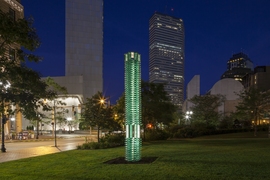
Adding a new dimension to her tenure as department head is that, in August, the Department of Architecture moves into its new home — the Met (W41). Faculty and students have for generations worked on Building 7’s fourth floor, which skirts around the building’s dome. The fragmented space is not optimal for building community and spontaneously sharing work designed in the various studios. The Met will provide a unified home for MIT Architecture — and for most of the Department of Urban Studies and Planning — where the disciplines and their research on the built environment may overlap.
“I think it’s a really exciting moment to transform physically where we are and how we relate to one another,” says Miljački. “I have brilliant colleagues in the department, but we’ve been spending too much time circling around the dome looking for each other. The new building provides a place for us to gather, to see each other’s work, and thus truly conduct our research and teaching in each other’s presence.
“Also, importantly, we will be in a building that is a great example of adaptive reuse by the architecture firm Diller Scofidio + Renfro. Reusing, recycling, and maintaining the existing architectural stock is what we need to figure out how to do well in the field of architecture right now. To be able to didactically read this building every day will be very important. Our move will literally help guide us in teaching and learning while it also signals both internally and externally our commitment to this necessary shift in the discipline.”
Histories and timelines
Miljački sees the project of an architectural school as a collective cultivation of utopia. Over the years and in various leadership roles at MIT, she has forged how she thinks of leadership itself.
“I now think that leadership importantly involves narrating stories in which we can all recognize ourselves,” she says. “For me, it may be primarily about fostering a sense of collective purpose in the face of an unacceptable status quo.
“Recently, I’ve been describing the school as a series of material, human, and other timelines, all unfolding at different speeds and tangling together to consequentially meet and materialize in the aging walls that surround us, in our care and labor protocols, in our pedagogies, collective and individual political investments, joys and heartaches. Cycles of global catastrophes and major weather events that arrive in the form of black and red clouds we all breathe in, connect us back to more- and less-recent forms of extraction here and elsewhere on the planet. Architectural fashions, and sometimes technical expertise, travel the same channels by which political action spreads. And importantly, learning and enabling of all sorts of action happen in many more ways that are not codified than those that are. Every school is its own version of this mesh of timelines, people, and things. I am humbled daily to take part in the MIT version of it, and to now take the helm on behalf of this collective.”