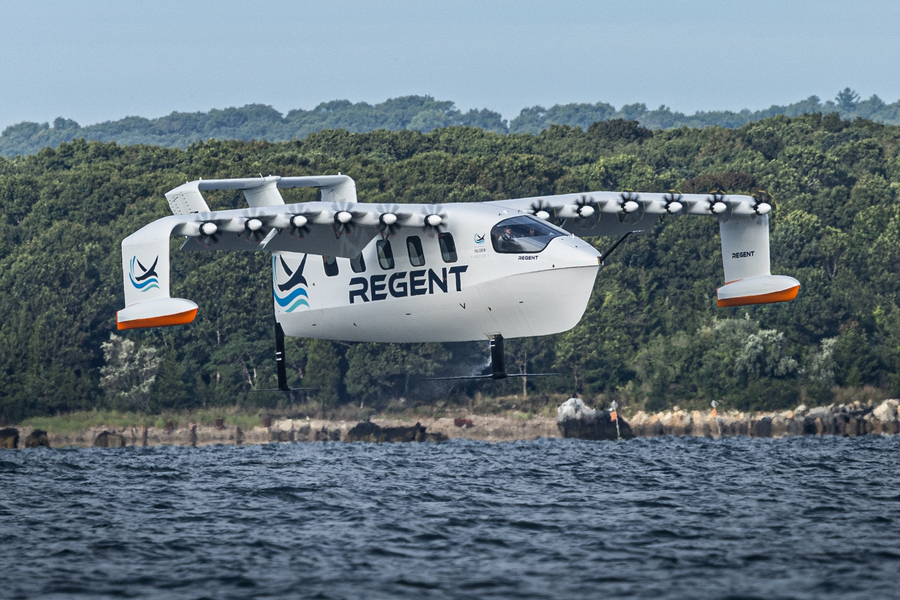
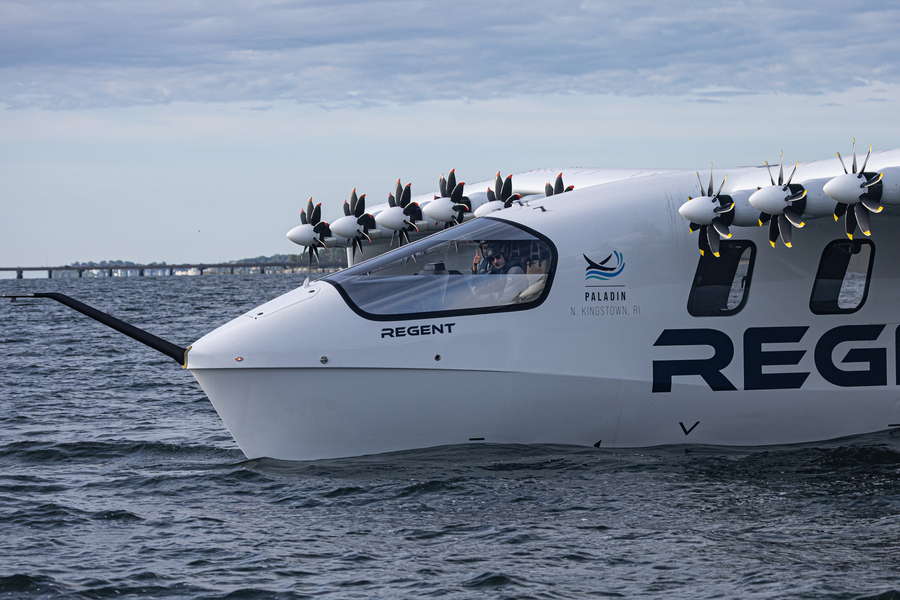
It’s a bird! It’s a plane! Actually, it’s a 50-foot long electric seaglider made by the MIT alumni-founded company Regent Craft.
Spectators at a recent demonstration could be forgiven for mistaking the unique vessel, which can float, hydrofoil across the water, and fly within a wingspan of the surface at speeds up to 180 miles per hour. The craft taps into the efficient aerodynamics that come from flying close to a fixed surface, to reduce drag and travel up to 180 miles on a single charge.
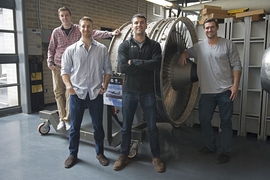
The vessel is the brainchild of Billy Thalheimer ’14, SM ’16 and Mike Klinker ’14, SM ’16, who met their first day as undergraduates at MIT. The founders hope their vessel, which can carry up to 14 people or about 3,500 pounds of cargo, can combine the speed of planes with the cost of ferries, all in a far quieter and more sustainable package.
“This is going to be an affordable, reliable, and high-speed mode to travel around coastal destinations,” says Thalheimer. “Think New York to the Hamptons, Miami to West Palm, or around the Hawaiian or Japanese Islands. It’s really like high-speed rail on every coastline of the world.”

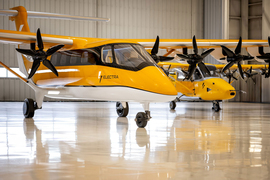
Regent has also flown a smaller, autonomous version of the passenger vessel for defense applications, including simulated missions with the U.S. Marine Corps for logistics and medical evacuations.
The company also recently opened a 255,000-square-foot manufacturing facility in North Kingstown, Rhode Island, which will be capable of producing about 70 passenger seagliders per year.
“We’ve really derisked the technology at this point,” Thalheimer says. “Both of our vessels have gone through their float, foil, and fly operations, and the performance has been really good, so now we’re full speed ahead moving into production.”
Valuable lessons
On a perfect July day in 2016, Thalheimer and Klinker stood on the bank of Boston’s Charles River with two other MIT graduate students sporting helmets and life jackets. They had been working toward this moment for months.
Red Bull’s annual Flugtag competition challenges teams to build and fly a human-powered machine over a body of water. Each year, the competition picks a site around the world for the rowdy celebration, and that year they happened to pick the MIT team’s backyard, making the students the proverbial home team.
The MIT community rallied around the students that summer, providing support and setting them up to build in the main lobby of the Department of Aeronautics and Astronautics, where they were in the process of getting their degrees. Their plan was to leverage the so-called ground effect, a phenomenon that gives aircraft increased lift and reduced drag as they fly close to a fixed surface like water.
With onlookers crowding along the edges of the water and floating on jetskis and makeshift boats, the announcer finally called the MIT team’s name. They confidently pushed their vessel off the edge to wild cheers. The aircraft promptly nosedived and crashed into the water.
“The flight went horrendously wrong,” Thalheimer says. “It was embarrassing, but it was also a really good lesson in engineering and risk mitigation. We decided to take that really seriously when we built our next flying machine.”
The experience also got the founders thinking a lot about ground effect. After graduation, Thalheimer and Klinker worked at the MIT spinout Aurora Flight Sciences, which was founded by John Langford ’79, SM ’83, SM ’85, PhD ’87.
One of Thalheimer’s first projects at Aurora was to design an electric vertical takeoff and landing (eVTOL) aircraft, which people were increasingly excited about. But the project showed Thalheimer eVTOL’s limitations: After accounting for requirements like backup power, altitude climbing, and headwinds, the most range he could get out of the aircraft was about 50 miles per battery charge. He also noted the regulatory landscape looked daunting.
Still, electrification of aircraft offered benefits like sustainability and cost efficiency.
“We were enamored with electrification,” Thalheimer says. “We saw the automotive industry get disrupted by a company that could use electrification better than incumbents. We thought that same Tesla moment is coming for aviation, but there were challenges. Our idea was to take this technology that we love and were really familiar with and bring it to this wing-in-ground effect vehicle in maritime.”
Applying electrification to a vessel that only flies over the water simplified the regulatory approach. The ground effect also gave the vessel more range because it flew on a cushion of air.
The approach had still other benefits. While jet engines have thousands of complex parts, Regent would have a battery with no moving parts and a motor with one moving part. Electric propulsion is also more quiet and sustainable.
Before the founders pitched investors they had to pitch the plan, which included quitting their stable jobs, to their fiancées, who gave them five months to pursue their startup idea.
One of the company’s early investors was E14, the MIT-affiliated venture fund. In 2021, they got into the startup accelerator Y Combinator, which accelerated the business. The following year they conducted their first demonstration flight with the smaller version of their vessel, called Squire.
Squire can move autonomously or be remotely operated. It can carry up to 50 pounds and travel 100 nautical miles per charge at 80 miles per hour. The founders say one of the applications the military is interested in is delivering blood or medical equipment to hard-to-reach areas.
The larger, passenger version, what the company calls Viceroy, has a 65-foot wingspan. It first flew this September. Both vessels can float on the water like a boat, hydrofoil across the water to reach takeoff speeds even in inclement weather, and fly just above the water.
“We’re flying on a cushion of air just like a bird skimming over the surface,” Thalheimer says. “That aerodynamic air cushion in the ground effect gives us high efficiency and therefore long range. That helps us tap into these other advantages: This is six times faster than a ferry but will be half the cost of an airline ticket.”
Innovating in transportation
The company expects the first vessels to be coming off its Rhode Island assembly lines toward the end of next year. Regent counts Mare Liberum, AE Ventures, Alaska Airlines, Japan Airlines, and Lockheed Martin as investors, and the founders say they have a large backlog of orders.
“Forty percent of the world’s population lives in and around the coastlines, so this connects a huge percentage of the world just by serving coastal communities,” Thalheimer says.
Whether for passengers, cargo, or military applications, the founders see Regent’s seagliders as breathing new life into an otherwise stagnant transportation sector.
“You look at all the ways the world has changed since the 1950s with medicine, the internet, mobile, and AI, and yet in transportation, if anything it takes longer to do a lot of the regional missions now because we have more traffic and congestion than the 1950s,” Thalheimer says. “That needs to change, and we can make a really big dent in the overall mobility space by focusing on maritime, because maritime has underutilized infrastructure, and most people live and move along the coast anyway.”