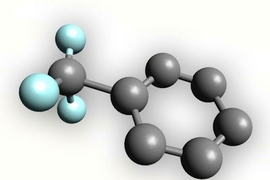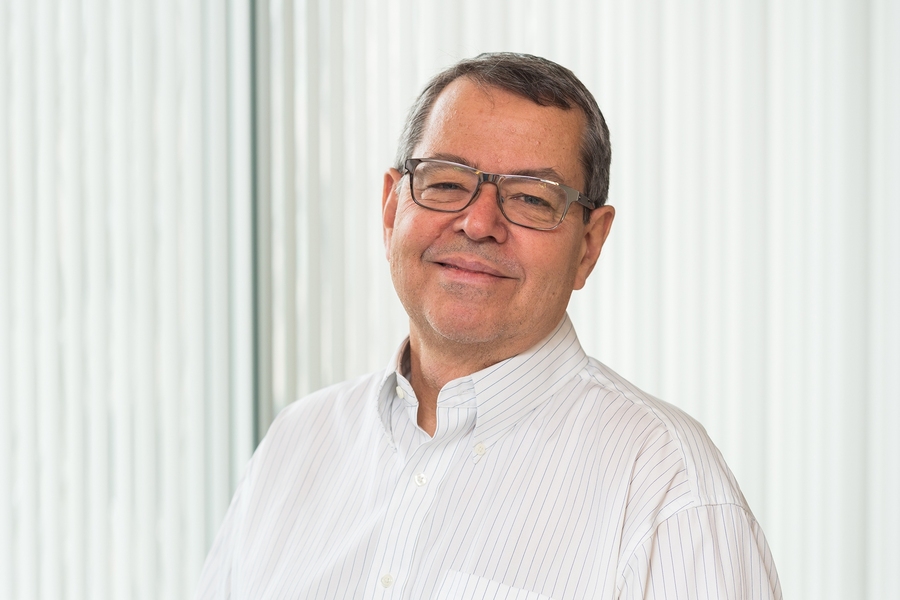
Camille Dreyfus Professor of Chemistry Stephen L. Buchwald has been named one of seven laureates across five categories honored with Israel’s 2019 Wolf Prize. Buchwald shares the award in chemistry with Professor John Hartwig of the University of California at Berkeley for their development of the Buchwald-Hartwig amination, a process used to improve the synthesis of large organic molecules.
“This award is due to the hard work and creativity of the graduate students and postdoctoral coworkers that I have been fortunate enough to have in my group during my over 30 years at MIT,” said Buchwald. “It also reflects the importance of funding basic research. In this case, the key finding came from work that had no practical application. However, based what we learned, we (and others) were able to develop new chemistry that is now widely used in industry as well as in academia.”
Buchwald received his BS from Brown University in 1977, and his PhD from Harvard University in 1982. Following a postdoctoral fellowship at Caltech, he joined the faculty at MIT in 1984, and was promoted to professor of chemistry in 1993. Among Buchwald’s numerous honors are the Linus Pauling Award, the Roger Adams Award, the Arthur C. Cope Award, BBVA Frontiers of Knowledge Award in Basic Sciences, and the Gustavus J. Esselen Award.
Research in the Buchwald Group combines elements of organic synthesis, physical organic chemistry, and organometallic chemistry to devise catalytic processes of use in solving problems of fundamental importance.
Ricardo Wolf, a German-born inventor who served as Cuba’s ambassador to Israel, established the Wolf Foundation in 1975 and the Wolf Prize, given in recognition of “achievements in the interest of mankind and friendly relations among peoples, irrespective of nationality, race, color, religion, sex or political view”, in 1978. Winners are selected by an international prize committee comprised of renowned experts in each field. The prestigious $100,000 awards are given in the fields of agriculture, chemistry, mathematics, medicine, physics, and art, and, within the filed of chemistry are widely regarded as second only to the Nobel Prize in terms of their stature.
Israeli President Reuven Rivlin will present Buchwald and the other 2019 laureates with their awards this May at a ceremony held at the Knesset Building (Israel’s Parliament) in Jerusalem.